

Summary
The Win2k.Stream virus was not found in the wild at the moment of creation of this description.The Win2k.Stream is the first known Windows virus using a "stream companion" infection method. This method is based on NTFS feature that allows a creation of multiple data streams associated with a file.
Removal
Based on the settings of your F-Secure security product, it will either move the file to the quarantine where it cannot spread or cause harm, or remove it.
A False Positive is when a file is incorrectly detected as harmful, usually because its code or behavior resembles known harmful programs. A False Positive will usually be fixed in a subsequent database update without any action needed on your part. If you wish, you may also:
- Check for the latest database updates
- First, check if your F-Secure security program is using the latest updates, then try scanning the file again.
- Submit a sample
- After checking, if you still believe the file is incorrectly detected, you can submit a sample of it for re-analysis.
- Note: If the file was moved to quarantine, you need to collect the file from quarantine before you can submit it.
- Exclude a file from further scanning
- If you are certain that the file is safe and want to continue using it, you can exclude it from further scanning by the F-Secure security product.
- Note: You need administrative rights to change the settings.
Technical Details
On NTFS system, each file contains at least one default data stream that is accessed just by file name. Each file may also contain additional stream(s) that can be accessed by their personal names (filename:streamname).The default file stream is the file body itself (in pre-NTFS terms). For instance, when an EXE file is executed, the program is read from the default file stream; when a document is opened, its contents are also read from the default stream.Additional file streams may contain any data. The streams cannot be accessed or modified without reference to the file. When a file is deleted, its streams are deleted as well; if a file is renamed, streams follow its new name.Windows package does not have any standard tools to view/edit file streams. You need to use special utilites to "manually" view file streams, for instance FAR utility with the file steams support plug-in (Ctrl-PgDn displays file streams for the selected file).The virus itself is a Windows application (PE EXE file), compressed by Petite PE EXE files compressor and it is about 4K long. When run, it infects all EXE files in the current directory and then returns control to the host file. If any error occurs, the virus displays the message:
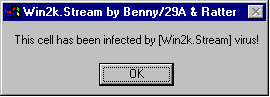
While infecting the file, the virus creates a new stream associated with the victim file. That stream has "STR" name, i.e. complete stream name is "FileName:STR". The virus then moves the STR stream to the victim file body (default stream, see above) and then overwrites the victim file body (default stream) with its (virus) code.As a result, when the infected file is executed Windows reads the default stream (that is overwritten by the virus code) and executes it. Also, Windows reports the same file size for all infected files - which is the virus length.The virus creates a new process by accessing the original file program with "FileName:STR" name to release control to host program.This infection method should work on any NTFS system, but the virus checks system version and runs only under Win2000.
Protect your devices from malware with F‑Secure Total
Protecting your devices from malicious software is essential for maintaining online security. F‑Secure Total makes this easy, helping you to secure your devices in a brilliantly simple way.
- Award‑winning antivirus and malware protection
- Online browsing, banking, and shopping protection
- 24/7 online identity and data breach monitoring
- Unlimited VPN service to safeguard your privacy
- Password manager with private data protection
Choose how many devices you want to protect to get started.

- Free customer support
- Cancel anytime
- The trial does not obligate you to buy the product
After 30 days your subscription will renew automatically for one year at €69.99.


More Support
Community
Ask questions in our Community.
User guides
Check the user guide for instructions.
Contact Support
Chat with our support for assistance.
Submit a Sample
Submit a file or URL for analysis.