

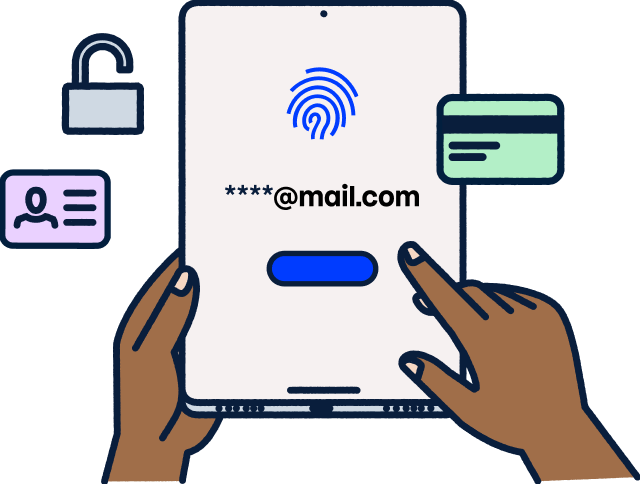
F‑Secure Identity Theft Checker
Check for a data breach: has your personal data been exposed on the dark web
F‑Secure helps you check if your private information appears in known data breaches. We don’t store your email address or your personal information.

Type in your email address
Use the email address associated with your accounts, such as Google or Facebook.

We search for breaches
We check whether personal information associated with this email address has been exposed in data breaches.

You receive a breach report
A breach report with recommended actions will be delivered to your email address.
F‑Secure does not store your email address or breach information.
For privacy reasons, no details about breaches will be given on this website.
Privacy policy
)
Breach report sent by email.
This might take a few minutes…
Your email is the key to many of your online accounts. However, breaches can also involve other sensitive information not tied to your email, such as:
Social security numbers
Credit cards
Passport numbers
Phone numbers
F-Secure Total checks previous breaches for these details and offers 24/7 monitoring to help you keep your identity secure from future incidents.

0
BREACHES FOUND
for {email account}
Your email is the key to many of your online accounts. However, breaches can also involve other sensitive information not tied to your email, such as:
Social security numbers
Credit cards
Passport numbers
Phone numbers
F-Secure Total checks previous breaches for these details and offers 24/7 monitoring to help you keep your identity secure from future incidents.
Why should you care about data leaks?
The average consumer has 229 stolen data records tied to their identity on the dark web.

of consumers have reused an exposed password.
credit card numbers exposed on the dark web in 2025.
National ID numbers exposed on the dark web in 2025.
full names exposed on the dark web in 2025.
of exposed consumer credentials included a plaintext password — immediately usable by criminals.
passports exposed on the dark web in 2025.
How you can deal with data leaks now
Even if your information has been leaked, you can still minimize the impact and prevent online criminals from using your personal information for profit.
Change your password
in any accounts where your information may have been leaked.

Get the F-Secure app
for personal assistance and complete online protection.
)
Try F-Secure Total for free for 30 days
F-Secure Total includes complete online security, scam protection, privacy and identity protection, in one brilliantly simple app.
Prevent identity theft with 24/7 monitoring and alerts
Browse securely with Privacy VPN
Block viruses and secure your browsing and banking
Avoid SMS scams, fake shops and malicious websites automatically
Award-winning security for your online life

Best protection

)
Best VPN
)
Best usability

Top performer in detecting fake shops

Certified banking protection
Related articles
- Article
)
How imposter scams generated $2.7 billion in just one year
Discover how scammers use AI to craft convincing impersonations, leading to billions in losses annually and learn effective protection strategies.
- Article
How AI scam calls work
Learn how criminals weaponize AI to clone voices and create convincing scam calls, and discover practical ways to identify and avoid these sophisticated threats.
- Article
Top 5 cyber security threats right now
Stay informed about the most pressing cyber security risks, including AI-powered attacks that use deepfake technology to bypass traditional security measures.
- Article
What are disinformation and misinformation?
False information explained: a guide to disinformation, misinformation, and their impact online.
- Article
5 scam detector and prevention tools to keep AI scammers at bay
Protect yourself with F‑Secure’s free online tools designed to identify and prevent sophisticated AI-powered scams before they compromise your security.

Frequently asked questions about the data breach checker
Find out if your private information has leaked in data breaches with F-Secure’s free data breach checker. Type in your email address and let the tool search for breaches.
If your email is hacked, immediately change your password to something strong and unique and log out of all active devices. Enable 2FA and use F‑Secure’s data breach checker to receive a report with recommended next steps. Finally, make sure to report the incident to your email provider and file an official claim at identitytheft.gov.
Common signs of hacking include unexpected password changes, account resets, messages being sent in your name and slow device performance. If you want to know if you have been hacked, type in your email address in F‑Secure’s data breach checker and see if your personal information has been compromised.
The tool searches a massive database of known data breaches and dark web leaks to see whether personal information associated with your email appears in any of them. Once you enter your email, F‑Secure generates a private report detailing what information was exposed and sends it to you with recommended next steps.
Yes, this checker is safe to use. F‑Secure does not store your email address or any breach information discovered during the search. For your privacy, the specific details of the leaks are sent only to the email address being checked, rather than displayed publicly on the website.
Identity theft refers to a situation in which someone uses another person’s personal information to carry out unauthorized activities, such as fraud, making purchases, or entering into loan agreements. Criminals can obtain your data through physical theft, public access to information, or data breaches. The best way to protect your identity online is to use strong passwords, two-factor authentication, an authentication key, and be careful what you share across different online services.
A data breach occurs when a hacker gains access to the database of a service or company that contains users’ private information. This information can range from usernames and passwords to social security numbers, addresses and even payment details. These lists are then usually sold online to criminal groups that seek to profit from this information.
It means one, some or all of your card details appeared in a known data breach. The tool flags any card data that has been exposed — whether that’s partial or complete information — because even partial card data can still be useful to criminals.
Fraudsters frequently combine pieces of information from multiple breaches — card digits from one leak, a name and address from another — to build a picture that’s detailed enough to commit fraud.
If your credit card has been breached, contact your card issuer to let them know and request a replacement card, check your recent statements for any transactions you don’t recognize, and turn on transaction alerts if you haven’t already.