

)
84% of consumers experienced an online scam attempt last year. Every fifth person fell for a scam, and 52% of those victims suffered financial losses (F-Secure Scam Intelligence & Impacts Report, 2026, n = 10,000). For every scam that succeeds, at least one support interaction follows: a dispute, a fraud report, a request for a refund, or simply a subscriber demanding to know why their provider did not warn them.
For telcos, Internet service providers (ISPs), and IT retailers who own the customer support cost line, scam-related contacts are among the most expensive they handle. They arrive without notice, they are emotionally charged, they take longer than standard support interactions to resolve, and they often end with a churn risk that was not present before the contact began.
This article examines the structural connection between scam exposure and support costs, quantifies the business case for proactive protection as a cost reduction tool, and explains how providers across Germany, Austria, France, Belgium, and the UK are repositioning scam protection from a subscriber benefit to a support operations strategy.
What this article covers
Why scam-related support contacts are structurally more expensive than standard interactions, and why their volume is rising.
How proactive scam protection reduces support volume by interrupting fraud attempts before they succeed.
How the same protection that reduces costs also builds subscriber loyalty and reduces churn.
How F‑Secure Horizon enables telcos, Internet service providers (ISPs), and IT retailers to offer proactive protection with minimal operational overhead.
The scam support ticket: what it actually costs
When a subscriber is scammed, whether through a fake SMS, a spoofed call impersonating their provider, or a fraudulent website that harvested their banking credentials, the support contact that follows is fundamentally different from a standard service query.
Standard support contacts are predictable: a subscriber asks about their bill, reports a connectivity issue, or requests a setting change. Resolution is typically short. The subscriber leaves the contact satisfied or at worst neutral.
Scam-related contacts are different in almost every dimension. The subscriber is often distressed or angry. The resolution requires investigating what happened, which involves time and cross-department coordination. The financial dispute process, if money was lost, adds further complexity. And the subscriber’s trust in the provider has already been damaged, not necessarily because the provider was at fault, but because the subscriber expected protection and did not receive it. 80% of consumers expect their provider to keep them safe from cyber threats (F‑Secure Digital Trust Report, 2026). When a scam succeeds, that expectation has been visibly unmet.
The consequence is a support contact that is more expensive than average, more likely to result in a compensation request, and significantly more likely to end in churn. Each unresolved scam incident creates a multiplier effect on the provider’s commercial position: the support cost, the churn risk, and the reputational exposure from negative reviews that affect new customer acquisition.
80%
of consumers expect their provider to keep them safe from cyber threats.
Source: F‑Secure Digital Trust Report, 2026, n = 10,000
Why scam contacts are rising and will continue to rise
The volume of scam-related support contacts is not static. The threat environment driving consumer scam exposure is intensifying across every market that matters to providers operating in Germany, Austria, France, Belgium, and the UK.
Scam attempts are becoming more frequent. 56% of consumers globally encounter scam attempts at least monthly. In France, that figure rises to 64%. In Germany it is 39%, which, while lower than the global average, still represents a substantial and rising volume of scam exposure across the German subscriber base (F-Secure Consumer Market Research, 2026).
The financial impact of successful scams is also rising. Fake invoice and debt scams, investment scams, and banking and payment scams, the three most common scam types in 2026, are all designed to transfer money directly from victims (F-Secure Scam Intelligence & Impacts Report, 2026). These are exactly the scam types that generate the most complex and resource-intensive support interactions, because the subscriber has lost money and is seeking recovery or compensation.
Tech support scams and fraud schemes that impersonate legitimate providers are a specific driver of call center volume. These scams often use the provider’s own brand name in the fraud. When the subscriber discovers they have been deceived by someone claiming to be their provider, the first call they make is to the real provider. These inbound contacts are unbudgeted, emotionally charged, and significantly longer to resolve than a standard support interaction, because the provider’s brand was invoked in the fraud itself.
The prevention model: why proactive protection reduces support volume
The commercial logic of proactive scam protection as a support cost reduction tool is based on a simple substitution: prevention is cheaper than clean-up.
A subscriber who receives AI‑powered SMS scam detection is warned before they interact with a fraudulent message. A subscriber protected by fake website blocking is redirected before they enter their banking credentials on a spoofed page. A subscriber with phishing protection receives a warning before their click on a fraudulent link completes. In each case, the scam attempt is interrupted before it succeeds, which means no financial loss, no fraud dispute, and no support contact.
The substitution is not perfect: not every scam attempt is intercepted, and some threat categories are outside the scope of any protection product. But the directional effect is measurable. Providers who offer proactive scam protection reduce the rate at which their subscribers become scam victims. Fewer victims means fewer scam-related support contacts. Fewer scam-related support contacts means lower support costs, lower churn from dissatisfied scam victims, and a support operation that is less exposed to the most resource-intensive contact type.
The framing that captures this logic most clearly is a cost comparison: the cost of offering scam protection as a value-added service versus the cumulative cost of the support contacts, compensation claims, and churn that a comparable subscriber base generates without it. Providers who have run this comparison internally have consistently found that proactive protection costs less than the reactive clean-up it replaces.
52%
of scam victims experienced financial losses in 2026, more than double the 22% who reported financial loss in 2025.
Source: F‑Secure Scam Intelligence & Impacts Report, 2026, n = 10,000
From cost center to loyalty driver: the retention argument
The support cost reduction argument is compelling on its own. But the commercial case for proactive scam protection extends beyond cost avoidance to active loyalty generation.
A subscriber who encounters a scam attempt and sees their provider’s protection intercept it before it succeeds has a materially different experience than a subscriber who encounters the same attempt and is not protected. The first subscriber has visible evidence that their provider is keeping them safe. That visible protection is a loyalty signal. It is also a differentiator in a market where 82% of consumers say the security offering influences their choice of provider (F‑Secure Scam Intelligence & Impacts Report, 2026). On top of that, 69% of consumers say they would switch provider based on that offering. A subscriber who perceives that their provider did not protect them from a scam faces conditions that drive the decision to switch. The support contact is the moment that perception is formed. Proactive protection removes the trigger before it reaches that point.
In other terms, the subscriber who is protected is more likely to stay. The subscriber who is not protected and falls victim more likely considers leaving. These are not abstract retention dynamics. They are the direct commercial consequence of the support cost model described above. The scam contact is the trigger event. Churn is the outcome. Proactive protection interrupts the trigger event before it occurs.
69%
of consumers would switch provider based on the security offering.
Source: F‑Secure Consumer Market Survey, 2026, n = 10,000
How F‑Secure Horizon supports the proactive protection model
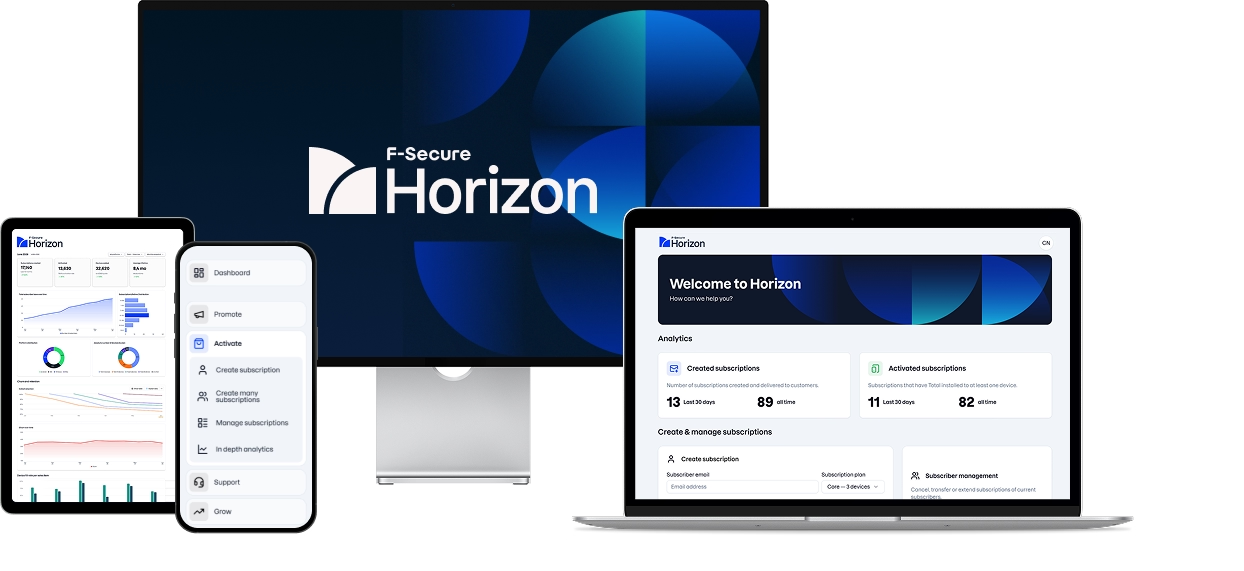
F‑Secure Horizon is a cyber security business platform that enables telcos, ISPs, and IT retailers to offer F‑Secure Total as a value-added service to their subscribers. Partners create subscriptions through the Horizon console. Subscribers receive a welcome email from F‑Secure and install F‑Secure Total on their devices.
F‑Secure Total Core, the entry-level consumer product available through Horizon, includes AI-powered SMS scam detection, fake website blocking, scam link interception, browsing and phishing protection, and banking protection. These are the capabilities that intercept the scam categories most likely to generate support contacts: smishing attempts, fraudulent websites, and phishing links.
F‑Secure also handles end-consumer support directly, which reduces the partner’s support overhead for the security service itself. Subscribers who have questions about the product, need installation help, or encounter an issue contact F‑Secure, not the partner’s call center. This is a direct operational benefit for providers who are adding the service precisely to reduce their support burden.
Most partners go live within days. F‑Secure Horizon is available from €99 per month with no setup fee and no long-term contract. It is ISO/IEC 27001 certified, which provides a credible compliance posture for providers operating in regulated DACH (Germany, Austria, Switzerland), Belgian, French, and UK markets.
Frequently asked questions
Scam-related contacts require investigation, cross-department coordination, and often involve financial dispute processes if the subscriber has lost money. They are emotionally charged, which extends handle time. And they arrive with a subscriber who expected protection and did not receive it, which means the contact carries a higher churn risk than a standard service query, regardless of how it is resolved.
Tech support scams and schemes that impersonate the provider’s own brand are a specific driver of call center volume, because subscribers contact the real provider to report or verify what happened. Fake invoice and debt scams, banking and payment scams, and investment scams generate the most complex support contacts because they involve direct financial loss and often require dispute handling. These are the three most common scam types affecting consumers in 2026, according to the F‑Secure Scam Intelligence & Impacts Report, 2026.
Proactive protection intercepts scam attempts before they succeed. A subscriber warned before interacting with a fraudulent SMS, before clicking a phishing link, or before entering credentials on a fake banking page does not become a scam victim. No victim means no fraud dispute, no compensation request, and no scam-related support contact. The prevention cost is the per-subscriber cost of the security add-on. The avoidance is the full cost of the support contact, compensation, and churn that would otherwise follow.
F‑Secure handles end-consumer support for F‑Secure Total directly. Subscribers with questions about the product, installation issues, or service concerns contact F-Secure, not the partner’s call center. This is a direct operational benefit for partners who are adding the service to reduce their support burden, not increase it.
A subscriber who sees their provider’s protection intercept a scam attempt has visible evidence that their provider is keeping them safe. That visibility builds loyalty. A subscriber who falls victim to a scam and perceives that their provider did not protect them is a churn risk. 82% of consumers say the security offering influences their choice of provider. Proactive protection turns a potential churn trigger, specifically a successful scam, into a retention signal instead.
Every scam contact costs twice: once in support time, once in subscriber trust.
The scam‑related support contact is not just an operational cost. It is evidence that the subscriber’s expectation of protection was not met. That unmet expectation is what drives the churn that follows.
The prevention model does not just reduce the cost of the contact. It removes the trigger event entirely. A subscriber who is protected does not become a victim. A subscriber who does not become a victim does not generate a support contact, does not file a dispute, and does not consider switching providers because they were let down.
Proactive scam protection is the mechanism that converts a reactive, cost‑driven support model into a proactive, loyalty‑generating one. The commercial case is not only that it reduces costs. It is also that it changes what the support interaction looks like before it happens.
If you are evaluating how proactive scam protection could reduce your support cost exposure while improving subscriber retention, the F‑Secure Horizon team can walk you through the commercial model and what the transition typically looks like in practice.
Explore F-Secure Horizon for telcos, ISPs, and IT retailers
About the author
F‑Secure Partner Content Team
Cyber Security Content Specialists, F‑Secure
This content is produced by the F‑Secure Partner Content Team using insights from partner program data, market research, the F‑Secure Digital Trust Report, 2026, and the F-Secure Scam Intelligence & Impacts Report, 2026. F‑Secure has more than 37 years of experience in cyber security and partner services.