
)
Quick answer: why is the point of device sale the highest-value moment to attach a cyber security subscription?
Every device sold leaves the store connected to the internet within hours. The customer who just bought a laptop, smartphone, or tablet is a target from day one. 84% of consumers experienced an online scam attempt last year, and 80% expect their service provider to help keep them safe (F-Secure Digital Trust Report 2026, n = 10,000). The point of sale is the moment when the commercial opportunity and the consumer’s need for protection coincide exactly. A hardware transaction generates revenue once. A security subscription attached at that moment generates revenue every month.
For IT retailers, current consumer threat landscape has direct commercial potential. Hardware margins in consumer electronics are structurally thin and not getting thicker. The device sale generates revenue once. The retailers building durable commercial positions are those treating the device sale as the start of a customer relationship, not the end of a transaction, and attaching a recurring security subscription that generates revenue long after the hardware margin is spent.
This scenario plays out across Europe every day. 84% of consumers experienced an online scam attempt last year, and every fifth person fell for one (F-Secure Scam Intelligence & Impacts Report 2026, n = 10,000). 80% of consumers expect their service provider to help keep them safe from these threats (F-Secure Digital Trust Report 2026).
This article examines the hardware margin challenge in plain commercial terms, makes the case for cyber security as the most practical recurring revenue add-on available at the point of device sale, and explains how IT retailers across the UK, Germany, Belgium, and France are structuring that transition.
What this article covers
Why hardware margins in consumer electronics are structurally thin and why volume growth alone cannot solve the problem.
Why the point of device sale is the highest-value moment to attach a cyber security subscription.
How the subscription revenue model works in practice for IT retailers using F‑Secure Horizon, from the sales conversation through to subscriber engagement.
Why a dormant subscriber is a churn risk, and how F‑Secure Horizon gives partners the visibility to act before that risk becomes a cancellation.
What the UK and EU regulatory environment means for IT retailers selling connected devices.
The hardware margin problem
A consumer electronics retailer with a revenue mix that is predominantly hardware faces a margin structure that is difficult to grow. Hardware margins in the consumer electronics category are thin by nature, set by manufacturer pricing, distributor competition, and the transparency of online price comparison. The most price-sensitive product category in retail is often also the largest revenue line for retailers who sell it.
The business model consequence is that growth requires either significant volume increases, which require investment in inventory, floor space, or online infrastructure, or a shift in the revenue mix toward products that carry higher margins and do not require physical inventory. Managed services and recurring software subscriptions are the established model for how technology resellers have addressed this.
The broader market dynamic reinforces this direction. Investment analysts have consistently observed that software and subscription-based business models trade at significantly higher valuations than hardware-focused businesses, reflecting the higher margins, lower churn, and more predictable revenue profiles that recurring services deliver. For a retail business with a large installed base of device buyers, a software-delivered recurring revenue line carries a cost structure that is fundamentally different from the hardware it accompanies.
84%
of consumers experienced an online scam attempt last year.
Source: F‑Secure Scam Intelligence & Impacts Report 2026, n = 10,000
Why the point of device sale is the highest-value attach moment for cyber security
Every device sold is connected to the internet within hours. The customer buying a laptop, smartphone, or tablet is making a digital life decision, and the moment they complete that purchase is the highest-intent moment for a security conversation they will have.
The threat environment that makes that conversation immediately relevant is not abstract. 56% of consumers encounter scam attempts at least monthly (F-Secure Consumer Market Research 2026). The scams targeting new device buyers, including fake parcel delivery texts, phishing links, and fraudulent shopping sites, are active from day one. A customer who leaves the store without protection is exposed the moment they connect.
The commercial logic is direct. A single hardware transaction generates revenue once. A security subscription attached at point of sale generates revenue every month for as long as the subscriber stays active. For a retailer whose floor space and staff time are already engaged in the hardware sale, the marginal cost of offering the security add-on is low. The recurring revenue potential compounds over time in a way that no hardware margin can.
The model is not new in the technology channel. Enterprise security businesses have built significant recurring revenue lines by treating hardware sales as the entry point for security service subscriptions. Most consumer electronics retailers have not applied the same logic to their consumer customer base. The ones that are doing so are building the margin resilience that hardware-only retailers do not have.
80%
of consumers expect their service provider to keep them safe from cyber threats.
Source: F‑Secure Digital Trust Report 2026, n = 10,000
What the subscription revenue model looks like in practice
The transition from hardware-only to hardware-plus-recurring-services requires the retailer to address three questions: what to offer, how to sell it at point of purchase, and how to manage and grow the subscriber relationship over time.
On what to offer
F‑Secure Total Core, available through the F‑Secure Horizon cyber security business platform, provides AI-powered SMS scam detection, fake website blocking, scam link interception, browsing and phishing protection, and banking protection across the subscriber’s devices. These features cover the threats consumers are actively encountering, which drives the daily engagement that sustains subscription renewal.
F‑Secure Total Complete adds identity protection, breach alerts, a password manager, VPN, and WiFi protection for subscribers who want broader coverage.
Retailers who position F‑Secure Total Complete as a natural upgrade option alongside F‑Secure Total Core, whether at the point of sale or through follow-up communications to their subscriber base, create a margin expansion opportunity that does not require a new device transaction.
On how to sell it
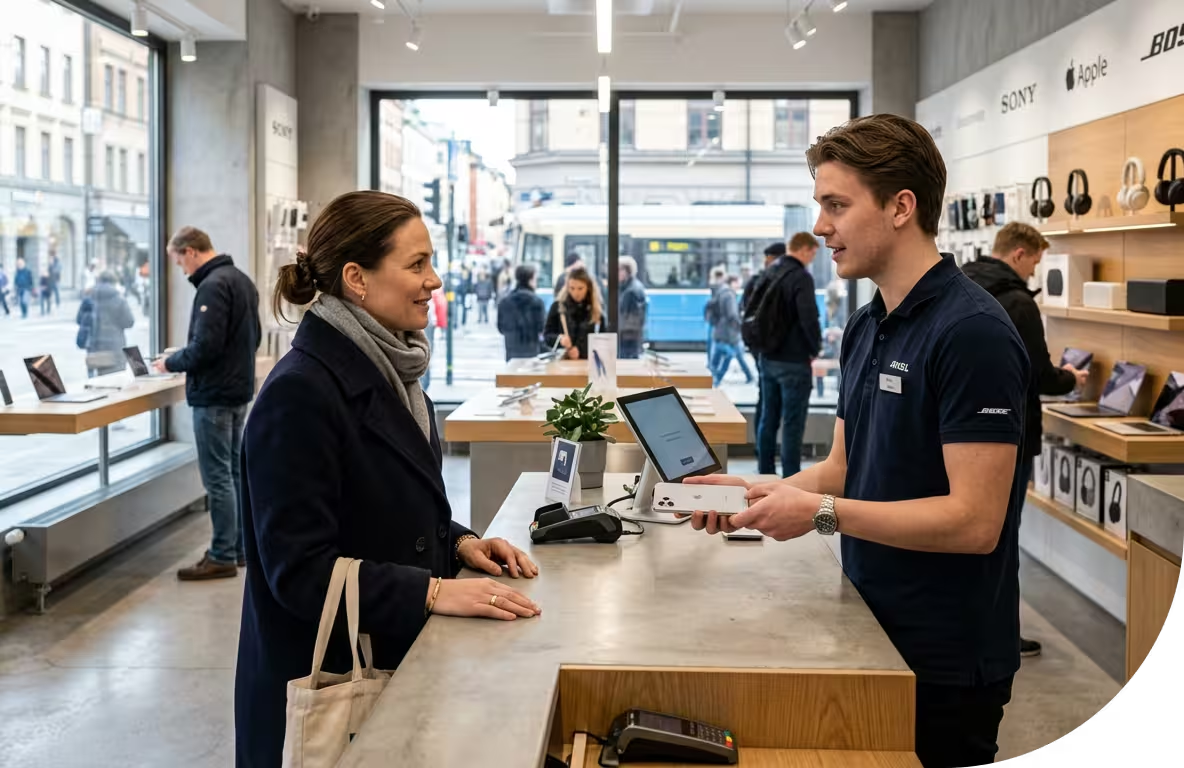
The point-of-sale conversation is the critical moment. Retailers who train their sales staff to introduce the security add-on as part of the device setup conversation, rather than as a separate upsell at the end of the transaction, achieve significantly higher attach rates. The conversation has three components: explaining what F‑Secure Total does and why it matters for this device, telling the customer to expect a welcome email from F‑Secure with installation instructions, and making clear that the product only protects them once it is installed on their devices.
F‑Secure Horizon’s Promote module provides ready-to-use sales training materials, campaign kits, and marketing assets for exactly this channel. The partner does not need to build a security sales capability from scratch.
On the mechanics
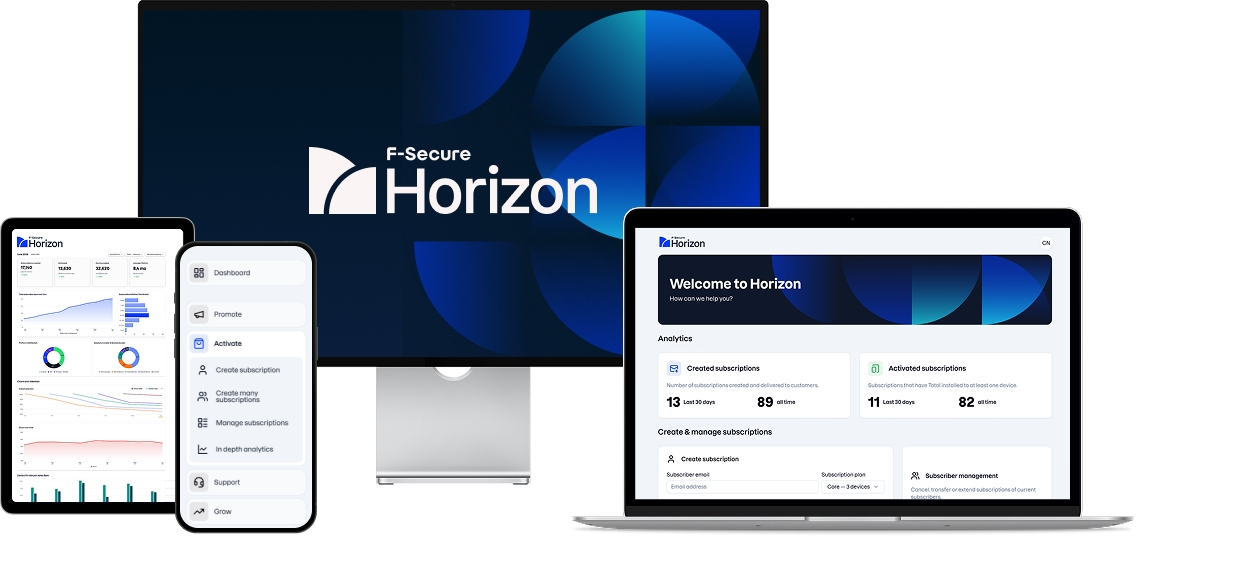
The partner creates the subscription in the Horizon console. F‑Secure then takes over the consumer-facing communication, sending the welcome email with installation instructions, and following up with installation reminders if the customer does not activate within the expected timeframe. If the customer installs on one device but has unused device entitlements, F‑Secure sends reminders prompting them to protect their other devices. The retailer manages the commercial relationship; F‑Secure handles the consumer activation journey.[LM1]
The subscriber after activation: why engagement is the real revenue driver
Creating a subscription is the start of the commercial relationship. What determines whether that subscription generates durable recurring revenue is whether the subscriber actually uses the product.
Consider two customers who both purchased a security subscription at point of sale. The first installed F‑Secure Total on their smartphone and laptop the day they received the welcome email. They receive scam detection alerts regularly, the banking protection activates when they check their accounts, and they have installed protection on their tablet as well. The second customer received the welcome email, intended to install the product, and never got around to it. Their subscription is live and billing each month. But they have no experience of the protection, no awareness of the value they are receiving, and no reason to renew when the time comes.
These two subscribers represent entirely different retention profiles. The engaged subscriber has built a daily habit around a product they associate with the retailer who sold it to them. The dormant subscriber is a churn risk. The difference between them is not which product they purchased. It is whether they activated it and filled their device quota.
Partners report up to a 30–60% reduction in core service churn when security is offered as a genuinely engaged value-added service, figures that are market and partner dependent (F-Secure Horizon partner program data). The retention benefit flows from active product use, not from subscription creation alone.
How F‑Secure Horizon gives partners visibility into subscriber engagement
The F‑Secure Horizon Grow module gives partners the operational visibility to understand where each subscriber sits on the engagement spectrum, and to act on that information before dormancy becomes cancellation.
Partners can see activation status for every subscription in their portfolio, device fill rate at the individual subscriber level and across the full base, feature adoption data showing which capabilities subscribers are using and on how many devices, and business key performance indicators (KPIs) including ARPU (average revenue per user), churn rate, and customer lifetime value. When a subscriber has a high device fill rate, meaning they have installed F‑Secure Total on most or all of their entitled devices, the correlation with longer subscription lifetime is measurable. When device fill rate is low, the partner has an early signal to act.
That signal is actionable. A retailer who identifies a cohort of subscribers who activated but never installed on their second or third device can target that group with a specific communication, whether a reorder-style reminder through their own customer channels or a prompt from the sales team, and move those subscribers to higher engagement before their renewal date arrives. The Grow module also surfaces AI‑powered insights that identify which product features correlate most strongly with subscriber retention across the partner’s base, giving the retailer data to inform both their marketing messaging and their point-of-sale conversation.
This is the SaaS operating model applied to consumer security retail. The retailer is not just selling a product once and hoping the customer renews. They have visibility into how the product is being used, where subscribers are disengaging, and which interventions are most likely to improve lifetime value.
82%
of consumers say security influences their choice of provider.
Source: F‑Secure Digital Trust Report 2026, n = 10,000
How F‑Secure Horizon reduces the operational barrier to entry
The argument for adding cyber security at point of sale is commercially sound. The barrier that has historically slowed retailers from acting on it is the perception that managing subscriptions, activations, and ongoing customer support requires infrastructure that a hardware-focused retail operation does not have.
F‑Secure Horizon is designed to address exactly that barrier. Partners access the platform, create subscriptions through the Horizon console, and F‑Secure manages the consumer-facing product experience, welcome communications, installation reminders, and support. The retailer does not need to become a security company to sell security subscriptions.
Most partners go from sign-up to creating their first customer subscriptions within three to five business days. The platform is available from €99 per month with no setup fee and no long-term contract, which allows retailers to launch with a manageable initial commitment and scale the subscription revenue line as attach rates grow. Partners who want to automate subscription creation as volumes increase can connect their existing Customer Relationship Management (CRM) or billing systems to Horizon via the Application Programming Interface (API) available on the Horizon Business tier. F‑Secure Horizon is ISO/IEC 27001 certified, providing a credible compliance signal for retailers in regulated European markets.
Frequently asked questions
Hardware margins in consumer electronics are structurally thin, set by manufacturer pricing, distributor competition, and the transparency of online price comparison. Volume growth requires investment in inventory, floor space, or online infrastructure. Technology resellers with hardware‑heavy revenue mixes operate on thin overall profit margins, and recurring revenue from managed services is widely identified as the primary mechanism for improving that structure.
Every device sold is connected to the internet within hours. 56% of consumers encounter scam attempts at least monthly, and the threats targeting new device buyers are active from day one. The attach opportunity exists at the moment when the consumer’s need for protection is highest and the retailer’s sales conversation is already under way. A single hardware transaction generates revenue once. A security subscription attached at that moment generates revenue every month.
F‑Secure Total Core includes AI‑powered SMS scam detection, fake website blocking, scam link interception, browsing and phishing protection, and banking protection across the subscriber’s devices. F‑Secure Total Complete adds identity protection, breach alerts, a password manager, VPN, and WiFi protection. Retailers who position F‑Secure Total Complete as a natural upgrade option alongside F‑Secure Total Core create a margin expansion opportunity that does not require a new device transaction.
A subscriber who holds an active subscription but has never installed F‑Secure Total generates no daily protection value and has no reason to renew. A subscriber who has installed across their devices, uses scam detection and banking protection regularly, and has filled their device quota has a product relationship that sustains renewal. Partners report up to a 30–60% reduction in core service churn when security is offered as a genuinely engaged value‑added service, though results are market and partner dependent. The Grow module in F‑Secure Horizon gives partners the visibility to identify the difference between these two subscriber types and act on it.
The Grow module gives partners real‑time visibility into activation status, device fill rate, feature adoption, and business KPIs including ARPU and churn rate at the portfolio level. Partners can identify subscribers who activated but never installed on their full device quota, understand which product features drive the strongest retention, and act on early churn signals before they become cancellations. F‑Secure Horizon also surfaces AI‑powered insights that connect engagement data to actionable marketing and sales recommendations for the partner.
The partner creates subscriptions in the F‑Secure Horizon console. The consumer receives a welcome email from F‑Secure with installation instructions and activates protection on their devices. F‑Secure handles consumer‑facing support, installation reminders, and device fill reminders. The retailer monitors engagement through the Grow module dashboard and manages the commercial relationship. Partners can introduce API‑based automation as subscription volumes grow.
Most partners go from sign‑up to creating their first customer subscriptions within three to five business days. F‑Secure Horizon is designed to be operational without complex development or custom integration at the start. Partners begin with manual subscription management through the Horizon console and can introduce API‑based automation as volumes grow. The platform is available from €99 per month with no setup fee and no long‑term contract.
The device sale is the start of the customer relationship. The subscription is how you keep it.
Hardware retailing will remain important. Devices matter and customers will continue to need them. The retailers building durable commercial positions are those treating the device sale as the beginning of a customer relationship, not the end of a transaction.
Cyber security subscriptions have the consumer demand, the margin profile, and the daily utility to be the most commercially productive addition to a device sale. 80% of consumers expect protection from the services they use. 84% encountered a scam attempt last year. The customer who left your store this afternoon with a new laptop is already a target. The security conversation belongs at the point of purchase, and the operational model to make it work, including the subscriber engagement visibility to sustain it, is now straightforward to access.
The retailers capturing this opportunity are not just adding a product line. They are building a recurring revenue engine that compounds over time, improves their margin structure, and creates a customer relationship that a price-comparison website cannot disrupt.
Explore F‑Secure Horizon for IT retailers
About the author
F‑Secure Partner Content Team
Cyber Security Content Specialists, F‑Secure
This content is produced by the F‑Secure Partner Content Team using insights from the F‑Secure Scam Intelligence & Impacts Report 2026, the F‑Secure Digital Trust Report 2026, the F‑Secure Global Consumer Market Survey 2026 (n = 10,000, 10 countries), and F‑Secure Horizon partner program data. F‑Secure has more than 37 years of experience in cyber security research and partner services. F‑Secure Horizon is ISO/IEC 27001 certified.
F-Secure Horizon ISO/IEC 27001 certification