

)
Introduction
Europe’s providers have long seen demand for connected protection services.
But a recent survey from F‑Secure Consumer Market Survey data shows this trend continuing, with 80% of consumers saying they expect their provider to offer protection services and 82% saying security plays a role in their provider selection.
But just because demand exists doesn’t mean telcos, ISPs, IT retailers, and insurers can capitalize on the opportunity. Service launches still take time — and traditionally slow operational processes create revenue delays.
Providers looking to generate recurring revenue from security services quickly need a platform that prioritizes onboarding efficiency.
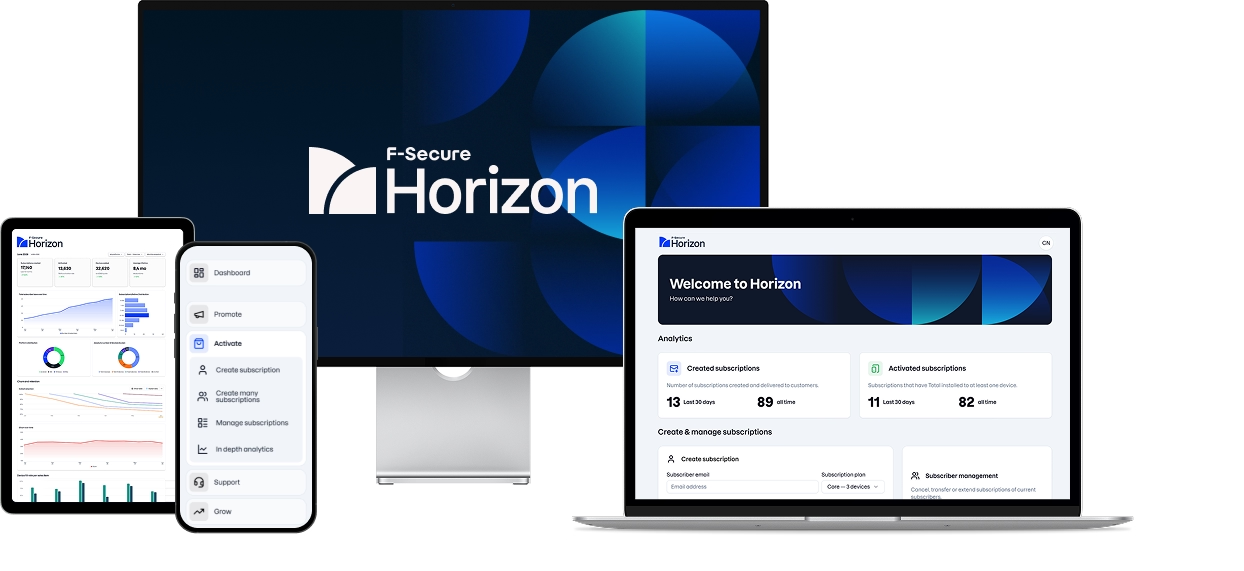
F‑Secure Horizon is an AI‑powered B2B SaaS platform that enables telcos, mobile virtual network operators (MVNOs), insurers, retailers, and service providers to resell F‑Secure Total — an award‑winning consumer cyber security product — to their own customers. F‑Secure Total is consistently recognized in independent evaluations for its protection capabilities, and industry data shows that 6 out of 10 communication service providers (CSPs) are prioritizing security as part of their core offering.
Let’s take a closer look at how self‑service platforms can eliminate operational friction points and create commercial opportunity from consumer cyber security services.
Removing operational friction from revenue generation
Whether telcos, retailers, or insurers, most providers recognize the potential demand for security services.
Getting services launched remains a key challenge.
Traditional security service deployments often require:
lengthy and complex provisioning processes
integrations requiring significant engineering effort
manual subscription activation
delayed billing processes
For providers looking to sell consumer cyber security services directly to consumers, lengthy provisioning processes and delayed billing may place strain on go‑to-market plans.
Service demand may exist, but long onboarding timelines create organizational hurdles that delay revenue generation.
With self‑service platforms, provisioning occurs through subscription consoles which dramatically simplify onboarding. Services can launch within days and billing can begin in time for the first subscription cycle.
Providers gain the ability to quickly capitalize on existing demand without losing potential revenue through slow provisioning timelines.
Why self‑service platforms support commercial scalability
Accelerated onboarding is just one phase of the customer lifecycle. Providers also need to consider operations from a scalability perspective.
Self‑service security platforms give providers:
fewer dependencies on engineering teams
centralized subscription management
streamlined activation processes
consistent billing operations
the ability to scale service acquisition
Self‑service security platforms are particularly effective for mid‑sized regional providers that lack large‑scale internal engineering resources.
That’s why providers can start with simplified self‑service onboarding and console‑based subscription management via F‑Secure Horizon, then adopt API‑based integration and automation as their business scales.
Security service providers gain the flexibility to launch quickly while keeping operations open to future growth opportunities.
Why launch friction affects revenue timing
Many providers evaluate new digital services based on customer demand and margin potential. However, launch timing can be equally important.
Delays in onboarding, provisioning, internal approvals, or integration work may postpone commercial outcomes even when market demand already exists.
For providers introducing consumer cyber security services, slow launch cycles can affect:
time to first revenue
customer acquisition momentum
campaign timing
partner enablement
competitive positioning
This is particularly relevant in telecom and ISP environments where value‑added services are often bundled into existing customer journeys.
Providers that simplify onboarding workflows can typically move faster from service planning to active subscriptions. Faster activation also allows providers to validate commercial performance earlier and refine customer acquisition strategies based on real usage data.
Reducing operational friction therefore supports both launch efficiency and revenue acceleration.
Consumer cyber security services: The margin opportunity
While operational efficiency enables providers to launch quickly, cyber security services themselves also need to make financial sense.
The good news is consumer cyber security services continue to present strong recurring margin opportunities for service providers.
F‑Secure service provider partners report up to 30–60% reduction in core service churn when security services are bundled onto existing services. Partner margins can range from 40–60% depending on pricing and positioning.
Those are attractive numbers for service providers, especially when cyber security services are inherently scalable and recurring.
Once providers establish the operational workflows for acquiring and activating new subscribers, additional customer acquisition can scale rapidly — and revenue grows accordingly.
Adding consumer cyber security services as an additional recurring source of revenue helps providers improve customer lifetime value while continuing to deepen relationships with customers.
Speed to market is competitive differentiation
Demand, retention, and revenue are all strong reasons for providers to offer consumer cyber security services.
However, providers should not expect the competition to wait.
Competitive pressures are increasing as consumers demand more protection from connected scams.
According to the Global Anti‑Scam Alliance (GASA), consumers lost more than 442 billion to scams globally, increasing expectations for providers to deliver integrated protection services.
For telcos, ISPs, insurers, and retailers looking to move into consumer cyber security services, the ability to launch quickly will increasingly become a competitive requirement.
Providers who want to not just compete, but lead, will need to think carefully about how to differentiate based on speed to market.
Providers relying on traditional security service deployment models are likely to face internal delays during onboarding. This allows competitors with more agile operating models to gain commercial advantages.
How F‑Secure Horizon streamlines the launch process
Consumer cyber security services do not have to come with enterprise‑grade complexity.
That’s why F‑Secure built Horizon around the idea that providers can gain quick access to consumer cyber security services without lengthy implementation delays.
Below are the four key operational phases providers gain access to through F‑Secure Horizon.
Promote
Providers gain access to F‑Secure branded marketing assets aligned to digital acquisition channels and customer engagement workflows.
Activate
Providers can create subscriptions without complex integration requirements using console‑based workflows.
Grow
Providers can monitor activation rates, customer adoption, and recurring revenue performance using built‑in analytics.
Support
Providers have access to operational support resources to help manage customer support and ongoing subscription administration.
With F‑Secure Horizon, providers gain the ability to streamline four crucial phases of service lifecycle management while retaining the flexibility to adopt new integrations as customer volume scales.
How self‑service platforms support partner operations
Launching consumer cyber security services involves more than technical deployment.
Commercial teams require marketing support, operations teams need subscription visibility, and customer support teams need manageable workflows for onboarding and service administration.
Self‑service platforms help centralize these activities.
With a single operational environment, providers can manage:
subscription activation
customer onboarding workflows
service visibility
lifecycle monitoring
recurring subscription operations
This becomes increasingly valuable for regional telecom providers, insurers, retailers, and ISPs operating without large internal engineering teams.
Operational simplicity reduces dependency on technical resources and enables broader internal adoption.
For providers evaluating recurring digital services, operational usability may influence long‑term success as much as product capability.
Removing barriers to go‑to-market success
Launching consumer cyber security services is easier than ever before, but the providers most likely to succeed are the ones that minimize operational friction during onboarding.
Providers taking a self‑service approach to consumer cyber security services will notice operational differences when compared to traditional deployment models.
Traditional deployment model | Self-service security platform model |
|---|---|
Months to deploy | Onboard in 3–5 days |
Engineering intensive | Limited engineering requirements |
Billing activation delayed | Revenue within the first billing cycle |
Multiple operational dependencies | Centralized subscription management |
Slower customer scaling | Scale services faster |
Providers that prioritize service efficiency gain the ability to deploy services rapidly, generate revenue sooner, and direct more resources toward growth activities.
With a self‑service platform like F‑Secure Horizon, providers that need to move quickly can gain early access to consumer cyber security services and begin generating recurring subscription revenue within the first billing cycle.
Without complex integration requirements at the start, providers remain free to evolve operations at the same pace business demands.
Ready to start selling consumer cyber security services?
F‑Secure Horizon makes it easier for providers to generate recurring revenue from consumer cyber security services.
F‑Secure Horizon pricing starts at €99 per month minimum monthly commitment with no setup fees or long-term contract. This allows providers to start building their consumer cyber security service quickly while scaling operations as demand grows.
F‑Secure Horizon pricing
https://www.f-secure.com/en/partners/solutions-and-services/horizon/pricing
Why speed to market increasingly matters
Consumer expectations around online protection continue to evolve.
According to the F‑Secure Consumer Market Survey, consumers increasingly expect providers to help protect them online, while security increasingly influences provider selection.
At the same time, scam activity continues to increase globally.
The Global Anti‑Scam Alliance reports more than 442 billion in annual scam losses worldwide, creating stronger expectations for integrated protection services.
For providers, this creates both:
a customer protection opportunity
a commercial opportunity
However, market opportunity alone is not enough.
Providers also need launch models that allow them to move quickly without introducing operational complexity.
This is why self‑service cyber security platforms are increasingly relevant within telecom, ISP, insurer, and retail environments.
Conclusion
Few things impact revenue generation quite like operational friction.
Providers slowed by onboarding delays, provisioning timelines, and integration complexity may struggle to capitalize on existing service demand.
That’s why providers should consider low‑friction self‑service alternatives that make it easier to generate recurring revenue from consumer cyber security services.
F‑Secure Horizon enables providers to launch consumer cyber security services quickly, reduce onboarding complexity, and begin generating recurring revenue within the first billing cycle.
Start building your consumer cyber security service with F‑Secure Horizon.
Frequently asked questions
A self‑service cyber security platform allows providers to launch and manage consumer cyber security services without heavy dependence on custom integrations.
Deployment with F‑Secure Horizon can take as little as 3–5 business days, with most partners able to generate revenue within the first billing cycle.
Consumer cyber security services help providers increase recurring revenue, strengthen customer retention, improve customer lifetime value, and reduce service churn.
F‑Secure Horizon is designed to help providers onboard quickly through console‑based workflows. While advanced integration and automation are supported via API, providers are not required to integrate at the time of setup.
F‑Secure Horizon is designed for telcos, MVNOs, ISPs, retailers, insurers, and other service providers looking to offer consumer cyber security services to their customers.
About the author
F‑Secure Partner Content Team
Cyber Security Content Specialists, F‑Secure
This article is produced by the F‑Secure Partner Content Team using insights from the F‑Secure Scam Intelligence and Impacts Report 2026, the F-Secure Digital Trust Report 2026, the Global Anti-Scam Alliance (GASA) Global State of Scams Report 2025, and partner program data. F‑Secure has more than 37 years of experience in cyber security research and partner services. F‑Secure Horizon is ISO/IEC 27001 certified.
Last updated: June 2026