

)
What is automated provisioning in mass-market cyber security?
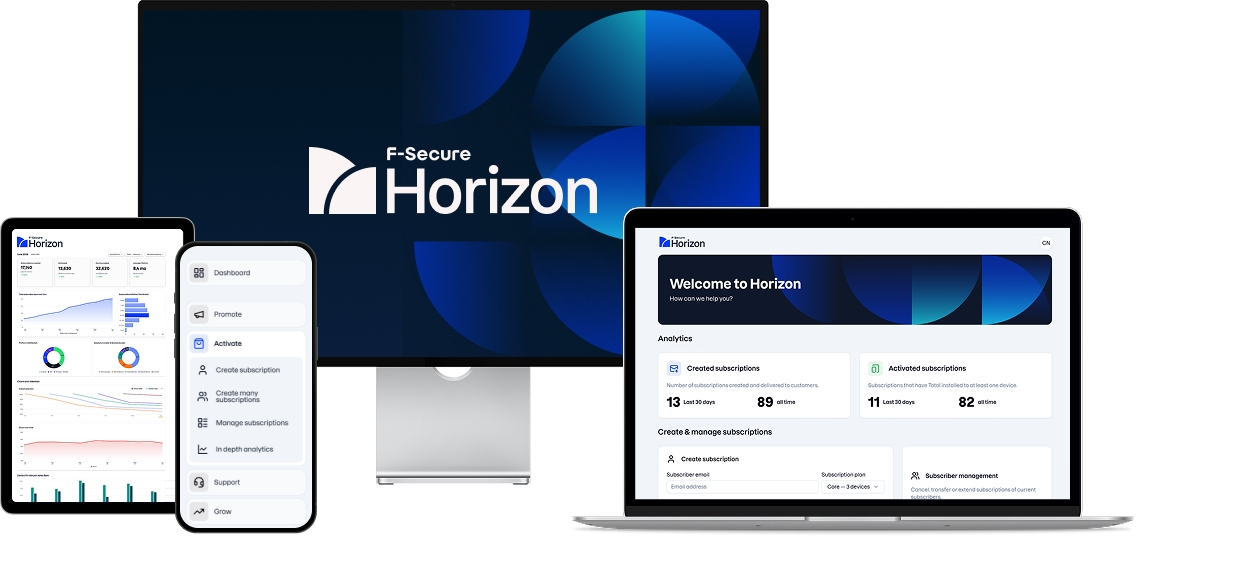
Automated provisioning in mass-market cyber security refers to the ability to create, activate, manage, and scale customer subscriptions without relying on manual processes for every step. Instead of handling every subscription, activation, or upgrade manually, providers use platforms that support these processes across the customer lifecycle more efficiently. Solutions such as the F‑Secure Horizon cyber security platform help partners manage high-volume consumer cyber security services efficiently while supporting long-term growth.
Survey results from the F‑Secure Consumer Market Survey 2026 have shown that 80% of consumers believe their provider should protect them, and 82% indicate security matters when choosing a provider. These stats paint a simple business picture — service providers need to scale effectively.
In practice, this allows providers to manage large customer volumes without increasing operational workload at the same pace.
Introduction: Growth creates operational pressure
Launching a cyber security service is one challenge. Scaling it to thousands of customers is another.
Many providers can manage the first few subscriptions manually. But as adoption increases, operational processes that worked during launch quickly become inefficient. Manual provisioning, subscription handling, and customer administration can become bottlenecks that slow down growth and increase internal workload.
It also affects whether customers activate and use the service. Delays or complexity during installation can prevent consumers from experiencing the value of the service, even when demand is strong.
This is a common challenge for providers moving from pilot-stage success to mass-market scale.
To grow efficiently, providers need systems that support both activation and scale.
That is why many service providers use platforms such as F‑Secure Horizon, which support manual onboarding initially and later enable automation as subscription volumes increase.
F‑Secure Horizon is an AI‑powered B2B SaaS platform that enables telcos, mobile virtual network operators (MVNOs), insurers, and IT retailers to resell F‑Secure Total — an award-winning consumer cyber security product — to their own customers.
Consistently scoring well in independent protection tests, F‑Secure Total is a great example of a security product providers can trust. 6 out of 10 communication service providers (CSPs) are making security a priority in their core offering.
Growth vs operational complexity
Growth stage | Operational reality |
|---|---|
Early launch | Manual processes are manageable |
Growing adoption | Manual work becomes a bottleneck |
Mass‑market scale | Automation becomes essential |
Revenue Start | Automation becomes essential |
Why mass-market security requires a different operating model
Selling cyber security to a broad customer base is different from managing a niche or enterprise security offering.
Mass-market services require providers to handle:
High subscription volumes
Frequent activations, upgrades, and terminations
Ongoing customer lifecycle management
Bundle changes and pricing updates
Churn monitoring and retention activity
Customer support at scale
Providers also need visibility into user adoption, activation behavior, subscription lifetime, and churn patterns in order to optimize service operations at scale. Operational analytics help identify friction points across activation, usage, and retention workflows.
At scale, even small inefficiencies in provisioning or onboarding can multiply into significant operational overhead.
At low volumes, many of these tasks can be handled manually. But once customer adoption grows, manual administration becomes difficult to sustain.
Without automation, growth can create more operational burden than business value.
This is why scalable providers typically move toward lifecycle platforms that support both operational efficiency and business growth.
What automated provisioning actually includes
Automated provisioning is often misunderstood as simple subscription activation. In reality, it covers a much broader part of the customer lifecycle.
A complete provisioning workflow typically supports:
Automatic subscription creation
Customer onboarding and activation (completed by the end user)
Plan upgrades and downgrades
Bundle management
Renewal and cancellation workflows
Revenue and subscription tracking
Customer lifecycle analytics
F‑Secure Horizon supports this progression by allowing partners to begin with manual subscription management and later move to API-enabled automation as operational needs increase.
This flexibility is important because not every provider needs full automation from day one.
These processes need to work together in a coordinated way.
From manual growth to automated scale
Most providers do not need automation immediately.
In the early stages, manual subscription creation is often the fastest and simplest way to launch. It allows teams to validate demand, test pricing, and refine their offer before investing in automation.
As subscriber numbers grow, however, manual processes begin to create friction.
That is typically the point where providers move from Horizon Essentials to Horizon Business, gaining access to API functionality and API functionality for operational automation.
Scaling journey with F‑Secure Horizon
The difference becomes clearer when compared to a traditional setup:
Stage | Approach |
|---|---|
Early stage | Manual subscription management (Horizon Essentials) |
Growth stage | Increasing operational demand |
Scale stage | API‑enabled automation (Horizon Business) |
F‑Secure Horizon starts from €99 per month, with no setup fee and no long-term contract, allowing providers to scale services without upfront investment.
This staged model allows providers to scale gradually rather than overinvesting in infrastructure before the business case is proven.
You can explore the available tiers on the F‑Secure Horizon pricing page.
The operational benefits of automation
Automating provisioning helps reduce administrative effort and improve consistency. It changes how efficiently the business can grow.
With automated provisioning, providers can:
Activate — automated subscription provisioning aligned with onboarding flows
Grow — analytics to track activation, churn, and revenue performance
Support — tools to manage lifecycle and reduce operational overhead
In practical terms, this allows the business to scale without increasing operational complexity at the same pace.
Over time, this creates a more predictable and scalable operating model.
Growth requires more than provisioning alone
Provisioning automation matters, but scaling a cyber security service also requires visibility into performance.
Provisioning alone is not enough for long-term growth. Providers also need operational visibility into activation rates, customer adoption, subscription growth, upgrade activity, and churn trends in order to optimize service performance over time.
To manage growth effectively, providers need insight into:
Activation rates
Subscription growth
Churn trends
Upgrade rates
Revenue by product
Campaign performance
This is why modern platforms combine provisioning tools with analytics and growth management features.
Key metrics for managing growth
Metric | Why it matters |
|---|---|
Activation rates | Measures onboarding success |
Subscription growth | Tracks demand |
Churn | Indicates retention |
Upgrade rates | Shows expansion potential |
Revenue by tier | Supports pricing decisions |
F‑Secure Horizon includes dedicated Grow and Support modules, allowing partners to track business performance while managing customer lifecycle activity in one place.
This creates a more complete operating model than provisioning alone.
Business impact: Automation supports scalable recurring revenue
The commercial value of automation is straightforward: providers can support more customers with less operational effort.
F‑Secure service provider partners have experienced 30–60% less core service churn when offering bundled security, along with 40–60% margins to partners (pricing and position dependent).
This improves margins, reduces internal cost pressure, and allows teams to focus on growth rather than administration.
According to the Global Anti-Scam Alliance (GASA) 2025 report, consumers lost over $442 billion to scams globally, reinforcing the need for scalable, provider-led protection services.
When cyber security is included as part of a broader service, it can increase perceived value and support customer retention over time.
Automation helps providers capture this revenue efficiently by making scale operationally manageable.
Providers that bundle security into existing services often see stronger engagement and long-term customer value.
Business impact of automated provisioning
Metric | Operational Impact |
|---|---|
Activation | Faster onboarding workflows |
Operational workload | Lower manual provisioning effort |
Error rates | Reduced subscription‑management errors |
Service visibility | Improved operational analytics |
Revenue scalability | Easier service expansion |
How F‑Secure Horizon supports automated provisioning and growth
F‑Secure Horizon is designed to support providers at different stages of growth.
Partners typically start with manual subscription management through Horizon Essentials and introduce automation as their operational needs grow.
The platform supports:
Manual subscription management for early-stage launches
API access to support automated provisioning at scale
Sandbox testing for workflow validation
Built-in analytics and performance dashboards
Marketing tools for campaign execution
Customer lifecycle and retention management
This staged approach helps providers scale responsibly, introducing automation only when operationally justified.
What this means in practice
Faster service activation
Lower operational overhead
Better scalability without additional resources
More consistent customer experience
Frequently asked questions
Most partners can begin operating within 3–5 business days and start generating revenue within the first billing cycle.
Yes. Automation reduces manual operational effort, allowing providers to scale revenue without increasing headcount at the same pace.
F‑Secure Horizon combines provisioning tools with analytics, marketing support, and customer lifecycle management to help partners grow and manage recurring revenue businesses.
Conclusion: Scaling security depends on operational simplicity
Scale for providers is not based purely on demand, but rather on how fast operations can enable it. Every delay in provisioning, activation, or installation can slow revenue generation and reduce operational efficiency.
With F‑Secure Horizon providers can scale consumer cyber security services and start monetizing in their first billing cycle with no operational overhead.
Build your consumer cyber security service with F‑Secure Horizon.
About the author
F‑Secure Partner Content Team
Cyber Security Content Specialists, F‑Secure
This content is based on insights from the F‑Secure Consumer Market Survey and Global Anti‑Scam Alliance (GASA) reports, partner program data, and market research. F‑Secure has more than 35 years of experience in cyber security and partner services.