

)
Quick answer: what does instant activation mean for digital service providers?
In the F‑Secure Horizon context, instant activation means the consumer has installed F‑Secure Total on at least one device. The partner creates the subscription, manually or via API. F‑Secure then takes over, sending the welcome email, installation reminders, and device fill reminders automatically. The partner monitors progress through the Horizon dashboard. No activation infrastructure needs to be built or managed by the partner.
Scaling a digital service is straightforward until subscription creation becomes the bottleneck. The first 100 subscriptions are manageable manually. The challenge starts when volumes grow and the operational weight of manual processes starts slowing everything down.
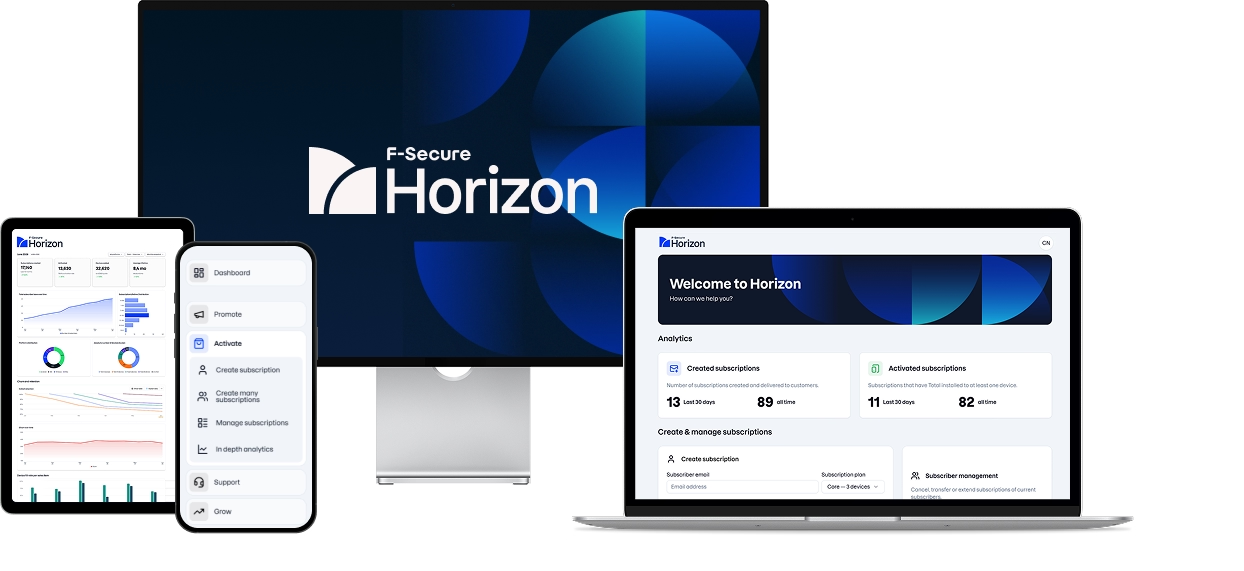
F‑Secure Horizon is Europe's first AI‑powered, self-serve cyber security business platform. It enables telcos, mobile virtual network operators (MVNOs), insurers, and retailers to offer F‑Secure Total, an award-winning consumer cyber security product recognized in independent evaluations, to their own customers.
80% of consumers expect their provider to help keep them safe online. 82% say security influences their choice of provider (F-Secure Global Consumer Market Survey 2026, n = 10,000). That demand is established. What determines whether a partner captures it is how efficiently subscriptions are created and how effectively consumers are supported through to installation.
This article covers the two distinct parts of that journey: subscription creation at scale, which the partner controls, and F‑Secure's automated consumer lifecycle messaging, which F‑Secure manages on the partner's behalf.
What this article covers
The difference between subscription creation and product activation, and why it matters.
How F‑Secure's automated consumer lifecycle messaging works after a subscription is created.
Where the partner's real lever in activation sits: the sales conversation, not email automation.
How the phased model from Horizon Essentials to Horizon Business works in practice.
The commercial case for getting both parts right.
Subscription creation and product activation are two different things
This distinction sits at the heart of how F‑Secure Horizon works and getting it wrong is the most common source of confusion in how the platform gets described.
Subscription creation: a partner action
Subscription creation is what the partner does. A team member logs into the Horizon console, enters the customer's email address, and selects the product tier. That creates the subscription and triggers F‑Secure's automated welcome email. Alternatively, on the Horizon Business tier, the partner connects their CRM or billing system to Horizon via the Subscription API. When a sales event is recorded, the API triggers subscription creation automatically with no manual step required in the console.
Whether manual or API-driven, what happens next is identical. F-Secure takes over.
Product activation: a consumer action
Activation means the consumer has installed F‑Secure Total on at least one device. This is something only the consumer can do. The partner cannot complete it on their behalf. The consumer receives the welcome email from F‑Secure, clicks the installation link, downloads the product from the relevant app store or desktop installer, and installs it. Activation is confirmed when at least one device is registered.
A subscription created but not activated represents a paying customer who is not yet experiencing the value they have purchased. That is why what happens between subscription creation and consumer installation matters so much.
How F‑Secure's automated consumer lifecycle messaging works
Once a partner creates a subscription, F‑Secure takes over the consumer-facing communication automatically. This is one of the most significant operational benefits of the Horizon platform and one that partners do not need to build or manage themselves.
What F‑Secure does automatically after subscription creation
F‑Secure sends the consumer a welcome email containing the product installation link. If the consumer does not install within the expected timeframe, F‑Secure automatically sends installation reminder emails. If the consumer installs on one device but has not used their full device entitlement, F-Secure sends reminders encouraging them to install on additional devices.
This full sequence runs without any operational effort from the partner. Internet service providers (ISPs), mobile virtual network operators (MVNOs), insurers, and IT retailers do not need to create reminder campaigns, manage activation email sequences, or build consumer onboarding infrastructure for a cyber security product. F‑Secure handles all of it.
Why this matters for partners at scale
Most digital service providers are not set up to run activation email sequences for a cyber security product. Building and maintaining that communication infrastructure would represent a significant operational burden on top of the core business of selling and managing subscriptions.
The Horizon model removes that burden entirely. The partner's role after subscription creation is to monitor results in the Horizon dashboard, not to manage the consumer communication workflow.
What the partner sees in the Horizon Grow module
The Grow module gives partners real-time visibility into the consumer activation journey without requiring them to manage it. Partners can see:
Activation rate: how many subscriptions have resulted in at least one device install.
Time to install: how long it takes consumers to install after receiving the welcome email and reminders.
Device fill rate: what proportion of entitled devices have been used across the subscriber base.
Reminder status: how many reminder emails F-Secure has sent to a given subscriber and whether they have acted.
This data gives partners the visibility to understand their activation funnel and identify where subscribers are dropping off, without needing to build the activation engine themselves.
F‑Secure manages automatically: welcome email, installation reminders, device fill reminders, consumer support.
Partner monitors via Grow module: activation rate, time to install, device fill rate, reminder status.
Neither requires the partner to build or operate consumer communication infrastructure.
Where the partner can genuinely impact activation
The partner's lever in activation is not email automation. F-Secure handles that. The partner's lever is the sales conversation at the point of purchase.
A sales team member who clearly explains what the consumer should expect, including the welcome email from F‑Secure, what the installation process involves, and the fact that the product does not work until it is installed on at least one device, will see significantly higher activation rates than one who does not.
When a consumer understands what is coming and why it matters, they act on the welcome email. When they do not, the email arrives without context and the installation rate drops.
F‑Secure Horizon supports this through the Promote module, which provides ready-to-use sales training materials, tutorial videos explaining the installation process, campaign kits, and product messaging guides. The partner uses these to train their sales team. The quality of the sales conversation is the single biggest factor in whether a consumer activates after receiving the welcome email.
Subscription creation at scale: from manual to API
The decision to automate subscription creation is a commercial and operational one, not a prerequisite for good consumer activation. F-Secure's automated lifecycle messaging works identically on both Horizon tiers. What changes between tiers is how the partner creates subscriptions, not how the consumer experiences the product.
What creates bottlenecks as volumes grow
Manual subscription creation works well at launch. A team member logs into the Horizon console, enters the customer's email address, and the subscription is created. At low volumes, this is manageable and gives the partner hands-on visibility into each subscription.
As subscriber volumes grow, manual creation introduces friction. Peak demand periods create backlogs. Human error risk increases. Internal operational workload grows faster than the business can absorb. This is the point where API automation becomes operationally justified.
Dimension | Manual subscription creation | API‑driven subscription creation |
|---|---|---|
How it works | Partner logs into Horizon console and enters customer email address. | Partner CRM or billing system triggers Horizon API when a sale is recorded. |
What is automated | Welcome email sending. Manual action is entering the email address. | Subscription creation step. No manual action needed in Horizon console. |
Consumer experience | Identical: F‑Secure sends welcome email, consumer installs product, partner monitors progress. | Identical: F‑Secure sends welcome email, consumer installs product, partner monitors progress. |
Activation speed | Not affected by creation method. Depends on the sales conversation and consumer action. | Not affected by creation method. Depends on the sales conversation and consumer action. |
Best suited for | Launch stage, lower volumes, or partners who prefer hands-on control. | Growing volumes where manual creation creates operational bottlenecks. |
The phased model: launch to Scale
Providers do not need automation on day one. The Horizon platform is designed for a staged approach that matches operational investment to actual business need.
At launch on Horizon Essentials, the partner creates subscriptions manually through the Horizon console. F‑Secure sends welcome emails and installation reminders automatically. The partner monitors activation rates, device fill rate, and subscription performance in the Grow module dashboard.
As volumes grow, the partner can move to Horizon Business and connect their CRM or billing system to Horizon via the Subscription API. Subscription creation becomes automatic when a sale is recorded. The consumer-facing activation journey remains identical. F‑Secure still manages all welcome emails and installation reminders.
Stage | Subscription creation | Consumer activation journey |
|---|---|---|
Launch (Horizon Essentials) | Manual: partner logs into Horizon console and enters customer email. | Automated by F‑Secure: welcome email, installation reminders, device fill reminders. |
Scale (Horizon Business) | Automated via API: partner CRM triggers subscription creation. | Identical: F‑Secure still manages all consumer-facing communications. |
The commercial case for getting both parts right
Subscription creation efficiency determines how quickly demand converts into revenue. Consumer activation determines whether subscribers stay and whether they experience the value they are paying for.
F‑Secure service provider partners report a 30–60% reduction in core service churn when security is offered as a value-added service alongside core offerings, figures that are market and partner dependent. Partners typically achieve 40–60% margin on consumer cyber security services, depending on pricing and positioning.
Those outcomes depend on consumers actually using the product. A subscriber who has not installed F‑Secure Total is not experiencing the protection they are paying for. They are a churn risk. The combination of efficient subscription creation and F‑Secure's automated lifecycle messaging is what closes the gap between subscription and active use.
30–60% reduction in core service churn reported by F‑Secure service provider partners when security is offered as a value-added service. Market and partner dependent.
40–60% typical partner margin on consumer cyber security services, depending on pricing and positioning.
F‑Secure Horizon starts at EUR 99 per month with no setup fee and no long-term contract.
F‑Secure Horizon starts at EUR 99 per month with no setup fee and no long-term contract. Most partners go from sign-up to creating their first customer subscriptions within 3–5 business days.
Key takeaways
For ISP product directors, MVNO commercial leads, telco partnership teams, and IT retail owners:
Subscription creation and product activation are two different actions controlled by different parties. The partner creates the subscription. F‑Secure manages the consumer lifecycle messaging automatically.
The partner's real lever in consumer activation is the sales conversation, not email infrastructure.
Moving from manual to API-driven subscription creation improves operational efficiency at scale but does not change how quickly consumers install the product.
Both tiers of F‑Secure Horizon benefit from the same automated consumer lifecycle messaging.
Frequently asked questions
In the F‑Secure Horizon context, instant activation means the consumer has installed F‑Secure Total on at least one device. The partner creates the subscription in the Horizon console or via API. F-Secure automatically sends the consumer a welcome email with an installation link. If the consumer does not install within the expected timeframe, F‑Secure sends installation reminders automatically. The partner monitors progress through the Horizon Grow module dashboard.
Most partners go from sign-up to creating their first customer subscriptions within 3–5 business days. No complex integrations are required to start. Marketing materials and sales training content are available from day one through the Promote module.
No. Most partners launch with manual subscription creation through Horizon Essentials and introduce API automation later as volumes grow. The consumer activation journey is identical regardless of which method is used. F‑Secure manages the welcome email and installation reminders automatically on both tiers.
No. The API automates subscription creation. It does not change how quickly a consumer installs the product. Activation speed depends on the quality of the sales conversation at the point of purchase and the consumer's own behavior after receiving the welcome email. The consumer-facing activation journey is managed by F‑Secure and is identical on both Horizon Essentials and Horizon Business.
F‑Secure sends the consumer a welcome email with the product installation link. If the consumer does not install within the expected timeframe, F‑Secure sends installation reminder emails automatically. If the consumer installs on one device but has unused device entitlements, F‑Secure sends reminders encouraging them to install on additional devices. The partner monitors all of this through the Grow module dashboard without needing to operate any consumer communication infrastructure.
At the point of sale. A sales team member who clearly explains what the consumer should expect, the welcome email from F‑Secure, the installation process, and the fact that the product does not work until it is installed on at least one device, will see significantly higher activation rates. F‑Secure Horizon's Promote module provides sales training materials, tutorial videos, and campaign content to support this conversation.
Scaling depends on getting both parts right
Subscription creation efficiency and consumer activation are separate problems with separate solutions. The partner controls subscription creation and can scale it from manual to API-driven as volumes grow. F‑Secure controls the consumer activation journey and manages it automatically through tested, sequenced messaging that requires no operational effort from the partner.
Understanding that separation is what allows partners to scale digital services efficiently without building activation infrastructure from scratch or becoming the bottleneck in their own consumer journey.
About the author
F‑Secure Partner Content Team
Cyber Security Content Specialists, F‑Secure
This article is produced by the F‑Secure Partner Content Team using insights from the F‑Secure Scam Intelligence and Impacts Report 2026, the F-Secure Digital Trust Report 2026, the F‑Secure Global Consumer Market Survey 2026 (n = 10,000, 10 countries), the Global Anti-Scam Alliance (GASA) Global State of Scams Report 2025, and partner program data. F‑Secure has more than 37 years of experience in cyber security research and partner services. F‑Secure Horizon is ISO/IEC 27001 certified.
Last updated: June 2026