

)
Quick answer: why is antivirus no longer enough for ISP subscribers in 2026?
Most consumer financial harm from cyber threats in 2026 comes from social engineering attacks: phishing links, fake websites, SMS scams, and fraudulent messages. These do not involve malicious files and do not trigger antivirus detection. Antivirus remains essential for file-based threats, but it was not designed for the interaction-layer attacks now responsible for the majority of consumer financial loss. ISPs can close this gap by offering AI‑powered scam protection as a value-added service through F‑Secure Horizon.
80% of consumers expect their provider to help keep them safe online. 82% say security influences their choice of broadband or mobile provider (F-Secure Global Consumer Market Survey 2026, n = 10,000). That expectation is not abstract. It translates directly into provider selection, subscriber retention, and recurring revenue potential.
For internet service providers (ISPs), the challenge is that the security product most subscribers are paying for was built for a threat model that no longer matches where most financial harm actually happens. Antivirus was designed to detect malicious files. The dominant threats consumers face today do not involve files at all.
This article explains the protection gap, why it matters commercially for ISPs, and how scam protection as a value-added service through F‑Secure Horizon closes it without requiring custom development or complex integration.
What this article covers
Why antivirus is no longer sufficient on its own against modern scam threats.
What the shift from file-based malware to social engineering means for ISP subscribers.
The commercial case for offering scam protection as a value-added service.
How F‑Secure Horizon enables ISPs to launch and scale a consumer cyber security service.
The approved target verticals for Horizon and how to get started.
The shift from malware to manipulation
For most of the history of consumer cyber security, the primary threat was technical. Criminals embedded malicious code in files and found ways to get those files onto devices. Antivirus was built to counter exactly this, and it remains effective for that specific threat model.
The problem is that the dominant threat model has changed. According to the F‑Secure Scam Intelligence and Impacts Report 2026, the most financially damaging attacks today do not rely on malicious files. They rely on convincing communication: a fraudulent SMS mimicking a parcel delivery service, a fake banking login page, an AI‑generated investment message using the name and photograph of a real financial adviser.
F‑Secure's internal threat research shows that 89% of scammers' AI use now focuses on improving the quality of their bait, producing polished, personalized messages at scale that remove the signals consumers previously used to identify fraud. 84% of consumers say they worry that AI will make it impossible to tell what is genuine online (F-Secure Scam Intelligence and Impacts Report 2026).
52% of scam victims lost money in 2026, more than double the 2025 rate.
89% of scammers' AI use focuses on improving bait quality.
84% of consumers worry AI will make it impossible to tell what is real online.
Source: F‑Secure Scam Intelligence and Impacts Report 2026
The Global Anti-Scam Alliance (GASA) Global State of Scams Report 2025 estimates global scam losses have surpassed US$442 billion. This scale of financial harm is not being driven by malware. It is being driven by deception at the interaction layer, precisely where antivirus has no detection surface.
Why antivirus alone is no longer enough
Traditional antivirus operates at the device file system level, identifying and neutralizing malicious code before it can execute. It does this through signature-based detection and heuristic threat analysis. It remains effective and necessary for file-based threats: malware, ransomware, trojans, and infostealers. Any credible consumer security offering needs this layer.
What antivirus was built to do
Traditional antivirus operates at the device file system level, identifying and neutralizing malicious code before it can execute. It does this through signature-based detection and heuristic threat analysis. It remains effective and necessary for file-based threats: malware, ransomware, trojans, and infostealers. Any credible consumer security offering needs this layer.
Where the gap opens
The gap opens when the attack does not touch the file system at all. A subscriber taps a link in a fake delivery text. A website opens that looks exactly like their bank. They enter their card details. The site captures them. No malicious file was downloaded. No executable ran. The antivirus had nothing to scan.
The same gap applies across the fastest-growing scam types in 2026. A fraudulent banking website gives antivirus nothing to detect. An AI‑generated investment message contains no malicious payload. A smishing link resolving to a credential-harvesting page triggers no signature.
These attacks succeed not by defeating technical defenses but by bypassing them entirely, targeting human judgment rather than device architecture.
Capability | Traditional antivirus | Scam protection |
|---|---|---|
Primary threat addressed | File-based malware: viruses, trojans, ransomware, infostealers | Social engineering: SMS scams, fake websites, phishing links, investment fraud |
Detection method | Signature-based and heuristic file scanning | AI‑powered behavioral pattern recognition at the interaction layer |
Channel coverage | Device file system | Browsing, SMS, transactions, links, online stores |
Consumer experience | Background scanning, invisible until a threat is found | Real-time warnings at the moment of risky interaction |
What it does not cover | SMS links, fake websites, AI‑generated scam messages | File-based malware — needs antivirus alongside it |
2026 relevance | Essential but insufficient alone | Closes the gap antivirus leaves open |
Both layers are necessary. Neither replaces the other. A consumer security offering that combines both addresses the full range of threats subscribers actually face in 2026.
What ISP subscribers expect and why it matters commercially
80% of consumers expect their provider to help keep them safe online. 82% say security influences their choice of broadband or mobile provider. 69% would consider switching provider based on the strength of a security offering (F-Secure Global Consumer Market Survey 2026, n = 10,000).
For ISPs, that data describes a retention problem as much as a product gap. Subscribers encountering scam attempts every month through a channel their ISP manages, with a security product that was not designed to catch those specific threats, are measuring their provider against a visible and recurring failure.
F‑Secure service provider partners report a 30–60% reduction in core service churn when cyber security is offered as a value-added service alongside connectivity, figures that are market and partner dependent. Partners typically achieve 40–60% margin on consumer cyber security services, depending on pricing and positioning.
80% of consumers expect their provider to keep them safe online.
82% say security influences their provider choice.
69% would consider switching based on the strength of a security offering.
Source: F‑Secure Global Consumer Market Survey 2026, n = 10,000
What AI‑powered scam protection means in practice for ISP subscribers
F‑Secure Total is the consumer product partners offer through F‑Secure Horizon. It is consistently recognized in independent evaluations for its protection capabilities.
F‑Secure Total Core includes AI‑powered Short Message Service (SMS) Scam Protection, browsing and phishing protection, banking protection, shopping protection, and device security across Windows, macOS, Android, and iOS. F‑Secure Total Complete adds ID Monitoring for identity theft alerts and breach notifications, a Password Vault, and a virtual private network (VPN) for privacy on unsecured networks.
In practice, this means a subscriber who receives a fake parcel delivery text sees a warning before they tap the link. A subscriber navigating to a spoofed banking site receives an alert before they enter their credentials. A subscriber browsing a fraudulent online store is blocked before they enter payment details. The protection operates at the moment of risk, not after the incident.
This is the interaction layer legacy antivirus cannot reach.
How F‑Secure Horizon supports ISPs through the full service lifecycle
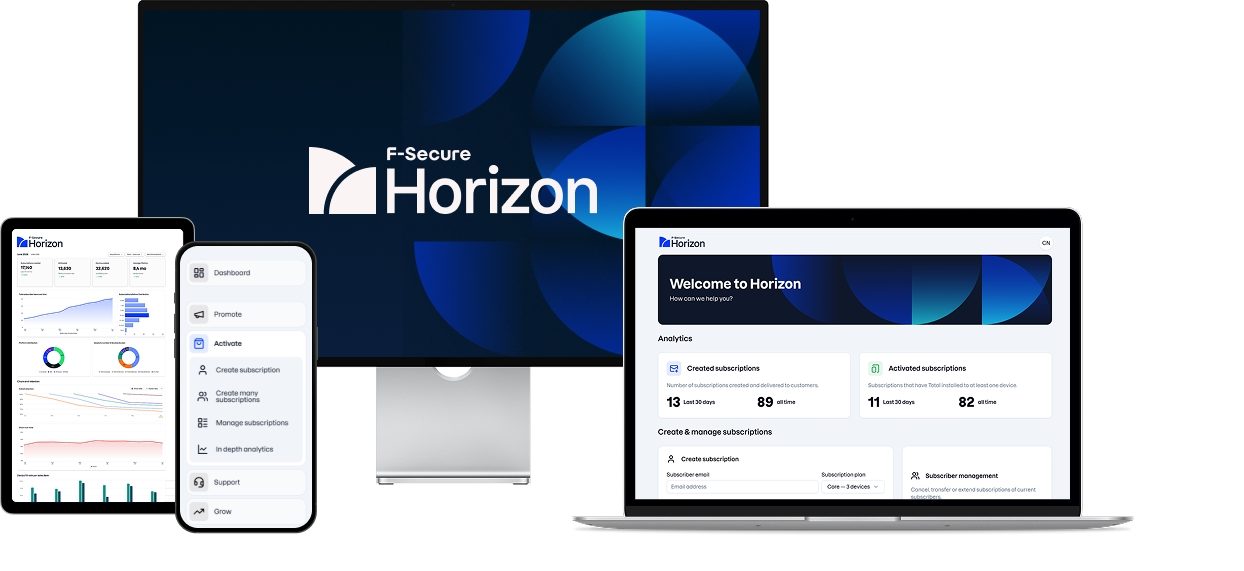
F‑Secure Horizon is Europe's first AI-powered, self-serve cyber security business platform. It is designed for organizations that already have a customer base and want to offer cyber security as a value-added service without custom development or complex integration at the start.
The platform is organized around four lifecycle modules that map to how ISPs launch, sell, and scale a consumer cyber security service.
The Promote module provides ready-to-use campaign kits, email templates, sales training materials, and product messaging guides. Partners can start sales conversations and run campaigns from day one without creating content from scratch.
The Activate module covers subscription creation and management. A team member logs into the Horizon console, enters the customer's email address, and selects the product tier. F‑Secure then sends the consumer a welcome email with an installation link and manages all subsequent installation reminders automatically. On the Horizon Business tier, partners can connect their customer relationship management (CRM) or billing system to Horizon via the Subscription application programming interface (API) to automate subscription creation as volumes grow.
The Grow module provides real-time analytics on subscription status, activation rates, device fill rates, feature usage, and business KPIs. Partners have the data to understand their activation funnel and commercial performance without building reporting infrastructure themselves.
The Support module covers partner assistance resources and F‑Secure's 24/7 end-customer support, which removes that operational burden from the partner's team entirely.
Partner creates subscription in Horizon console or via API.
F‑Secure sends welcome email and manages all installation reminders automatically.
Partner monitors activation rates, device fill rate, and business KPIs in the Grow module.
No consumer support burden on the partner. F‑Secure handles end-customer queries.
Who F‑Secure Horizon is designed for
F‑Secure Horizon is designed for organizations that already have an established customer base and want to add cyber security as a value-added service without building a security product from scratch.
ISPs and connectivity providers occupy the strongest natural fit. Connectivity is the channel through which consumers encounter the majority of online threats. Phishing links, smishing messages, and fraudulent websites all reach consumers through the same connection the ISP already provides. Cyber security is a natural extension of that relationship.
Mobile virtual network operators (MVNOs) and telcos face the same logic on mobile. Mobile subscribers manage banking, payments, and daily communications on the same device receiving fraudulent messages. A cyber security service that a subscriber uses daily creates engagement and loyalty that price competition alone cannot match.
IT retailers and device distributors have a natural sales moment at checkout. Every device sold is a device that needs protecting. A recurring cyber security subscription attached to a device sale generates ongoing revenue from the same customer without additional inventory.
Insurance providers see a dual commercial benefit: a value-added add-on that differentiates their policy offering and proactive protection that helps reduce the likelihood of cyber-enabled fraud claims.
How partners typically launch with F‑Secure Horizon
Most partners go from sign-up to creating their first customer subscriptions within 3–5 business days. No complex integrations are required to start. The Promote module provides sales training and campaign materials from day one. Partners begin with manual subscription creation through Horizon Essentials and introduce API-driven automation on Horizon Business as volumes grow.
F‑Secure Horizon starts at EUR 99 per month with no setup fee and no long-term contract.
Key takeaways
For ISP product directors, MVNO commercial leads, and telco partnership teams:
Antivirus remains necessary but is insufficient alone against modern scam threats.
The majority of consumer financial harm in 2026 comes from social engineering attacks that bypass antivirus detection entirely.
80% of consumers expect their provider to help keep them safe.
Adding scam protection as a value-added service through F‑Secure Horizon closes the protection gap, supports subscriber retention, and generates recurring margin without requiring custom development.
Frequently asked questions
Because the most financially damaging threats consumers face today do not involve malicious files. Phishing websites, SMS scams, fake online stores, and social engineering attacks operate at the interaction layer and do not trigger antivirus detection. According to the F-Secure Scam Intelligence and Impacts Report 2026, 52% of scam victims lost money in 2026, more than double the 2025 rate. Antivirus remains essential for file-based threats but does not address this growing category of harm.
Scam protection uses AI‑powered pattern recognition to detect and warn consumers about fraudulent links, fake websites, smishing messages, and suspicious interactions before they engage with them. Antivirus operates at the device file system level and detects malicious files. The two are complementary: antivirus covers file-based threats, scam protection covers interaction-layer threats. F‑Secure Total Core includes both in a single product.
F‑Secure Horizon provides four lifecycle modules. Promote covers sales enablement and marketing materials. Activate covers subscription creation, both manual and API-driven. Grow provides real-time analytics on activation rates, device fill rate, and business KPIs. Support covers partner assistance and F‑Secure's 24/7 end-customer support. Once an ISP creates a subscription, F‑Secure manages the consumer-facing onboarding automatically, including the welcome email and installation reminders.
F‑Secure Horizon is designed for ISPs, MVNOs, telcos, IT retailers and device distributors, and insurance providers operating in European markets. Banks, neobanks, and fintech companies are not confirmed target verticals for Horizon. Partners should contact the F‑Secure partner team to confirm whether their organization type is eligible.
Most partners go from sign-up to creating their first customer subscriptions within 3–5 business days. No complex integrations are required at the start. Sales training and campaign materials are available from day one through the Promote module. F‑Secure Horizon starts at EUR 99 per month with no setup fee and no long-term contract.
No integration is required to start. Partners begin by creating subscriptions manually through the Horizon console. The Subscription API is available on the Horizon Business tier for partners who want to automate subscription creation as volumes grow. API adoption is optional and is not required to access F‑Secure's automated consumer lifecycle messaging, which runs on both tiers.
Protection needs to match how threats work today
Antivirus still plays a role in consumer cyber security. But it is no longer sufficient on its own. Modern threats target human judgment rather than device architecture, and they operate in channels antivirus was never designed to reach.
For ISPs, this creates a specific commercial opportunity. Subscribers already expect their provider to help protect them online. The demand exists. The platform to meet it is ready. Scam protection as a value-added service through F‑Secure Horizon closes the gap between what subscribers expect and what most ISPs currently offer, without requiring a security engineering team or a lengthy build cycle.
About the author
F‑Secure Partner Content Team
Cyber Security Content Specialists, F‑Secure
This article is produced by the F‑Secure Partner Content Team using insights from the F‑Secure Scam Intelligence and Impacts Report 2026, the F‑Secure Digital Trust Report 2026, the F‑Secure Global Consumer Market Survey 2026 (n = 10,000, 10 countries), the Global Anti-Scam Alliance (GASA) Global State of Scams Report 2025, and partner program data. F‑Secure has more than 37 years of experience in cyber security research and partner services. F‑Secure Horizon is ISO/IEC 27001 certified.
Last updated: June 2026