

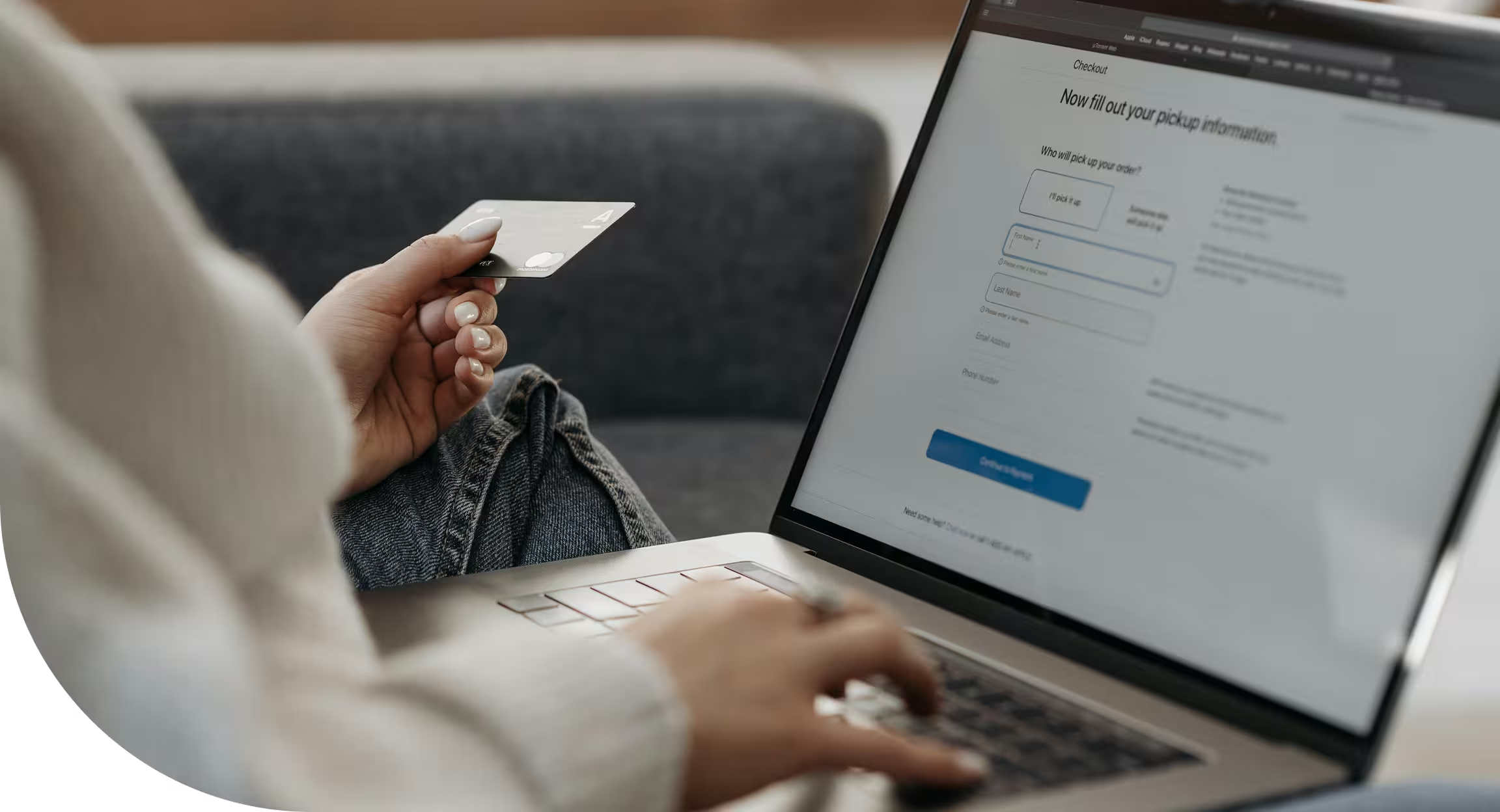

What if the price you're shown online has less to do with the product, and more to do with you?
You may be paying a hidden premium when shopping online, determined not by what you buy or when you buy it, but by who you are. In fact, two people can look at the same product at the same moment yet see completely different prices—not because of sales, stock levels, or errors, but simply because one is shopping on a Mac, living in a particular zip code, or standing in a store's parking lot.
That's the result of surveillance pricing, where online retailers use advanced data collection, predictive algorithms, and AI to profile shoppers, predict the maximum each person would be willing to pay, and set prices within milliseconds.
What Is Surveillance Pricing—and Why Are Retailers Using It?
Surveillance pricing is reshaping e-commerce in ways most consumers never see, with retailers using vast pools of personal information to tailor prices in real time. To the shopper, the experience looks normal. But beneath the surface, it's deeply personalized—often leaving some consumers paying more simply because an algorithm thinks they will.
This practice has grown rapidly due to more affordable processing power, more accurate machine learning models, and a surge in the availability of personal data, especially in countries with weaker data protection regulations, such as the United States.
Real-World Examples of Surveillance Pricing in Action
The impact of surveillance pricing becomes clearer when you look at how it's already being used today. A 2024 Consumer Watchdog report documented several real-world cases, including:
Orbitz: Charged Mac users more for hotels after learning they typically spent as much as 30% more on bookings.
Staples: Charged higher prices for the same stapler to people who lived farther from competing stores such as OfficeMax or Office Depot.
Target: Used geofencing in 2021 to charge shoppers more when they were physically in a Target parking lot—a practice that later resulted in a $5 million civil penalty.
The Princeton Review: Charged higher prices to students in zip codes with higher concentrations of Asian residents.
Uber: Users have reported different pricing based on factors like corporate vs personal credit cards. In 2016, an Uber data scientist also noted that people are more willing to pay higher fares when their phone batteries are low—though Uber denies using battery data for pricing and says that they calculate fares based on "trip purposes."
The Growing Scale of Surveillance Pricing
In July 2024, the US Federal Trade Commission (FTC) used its subpoena power to order eight surveillance pricing vendors (Mastercard, Revionics, Bloomreach, JPMorgan Chase, Task Software, PROS, Accenture, and McKinsey & Co.) to submit documentation about the data and methods used so the agency could assess the impact of surveillance pricing.
In January 2025, the FTC released its initial study. It found that over 250 retailers are relying on "middleman" companies to build and operate surveillance pricing systems that aggregate extensive personal data to predict what each consumer is likely to pay. These predictions are then used to set individualized prices, raising major concerns about consumer privacy, fairness, and market competition.
How Algorithms Decide What You'll Pay
The objective of surveillance pricing is simple: estimate the highest price a specific customer is willing to pay, then adjust the price to match it in real-time.
To do this, retailers track consumer behaviors—such as cursor movements, browsing patterns, and which items shoppers add to a cart and abandon—and feed this data into pricing systems.
The Data That Drives Surveillance Pricing
The data powering these pricing models goes far beyond typical shopping habits. Retailers may tailor prices based on factors such as:
Competitor pricing
Precise location
Browser history
Purchase history
Consumer preferences
Demographics
Other real-time behavioral data
How Retailers Gather the Data That Shapes Your Price
Collecting this level of personal and behavioral insight requires a sophisticated data pipeline. To achieve surveillance pricing, companies use systems that combine:
Advanced prediction algorithms and artificial intelligence
Real-time bidding data from advertising networks
Consumer digital surveillance techniques, such as:
Location tracking and geofencing
Browser fingerprinting and tracking pixels
Purchase history analysis
Demographic profiling
Surveillance Pricing vs Dynamic Pricing: What's the Difference?
Dynamic pricing refers to prices shifting frequently based on competition or supply conditions—like airline fares, which can change by day or time. It's driven by marketplace factors, not the identity of the shopper.
Surveillance pricing is a specific form of dynamic pricing that incorporates who the shopper is. According to the FTC, it factors in "where the consumer is, who the consumer is, what the consumer is doing, and prior actions a consumer has taken, such as clicking on a specific button or element on a webpage, watching a video, or adding items to shopping carts."
)
While many large retailers deny using personal data to set individualized prices, some—like Amazon—acknowledge using dynamic pricing. The FTC notes that these companies collect the same types of data required to enable surveillance pricing, raising concerns about how quickly dynamic pricing could evolve into individualized, surveillance-driven pricing.
Is Surveillance Pricing Legal? The Current Regulatory Landscape
Surveillance pricing sits in a legal grey area in many parts of the world. In the United States, the practice isn't explicitly banned at the federal level, though regulators are increasingly scrutinizing how companies gather and use personal data to set prices. In Europe, meanwhile, GDPR imposes stricter requirements—particularly around transparency, lawful processing, and profiling.
United States: The Emerging Regulatory Response
In the US, regulators are responding on two fronts: federal scrutiny led by the FTC and a growing wave of state-level proposals.
Federal Trade Commission actions
July 2024: FTC issued 6(b) subpoena orders to eight companies seeking information on surveillance pricing practices.
January 2025: FTC released initial findings revealing extensive use of personal data for price discrimination.
Spring 2025: FTC requested public comments regarding surveillance pricing practices.
State-level initiatives
California:
The state of California Assembly passed AB 446, which would prohibit any person or company from engaging in surveillance pricing, and the California Senate passed the Fair Online Pricing Act (SB 259), which would prohibit businesses from offering prices based on device information or geolocation data.
As of August 2025, both bills are currently working their way through committees and have yet to become law.
As of September 2025, the AB446 was pulled from consideration by its sponsor, effectively killing it.
Target agreed to pay a $5 million settlement after San Diego, CA district attorneys accused the company of surveillance pricing practices that amounted to deceptive advertising.
New York:
In 2025, New York passed the Algorithmic Pricing Disclosure Act, which requires certain businesses to disclose when a price is set using an algorithm based on personal data. The National Retail Federation challenged the law in court, arguing that it violated the free speech rights of retailers. In October, a federal judge rejected the challenge, and in November the New York Attorney General encouraged consumers to report businesses that failed to comply.
Other States:
Lawmakers in several states have introduced more than a dozen bills to regulate "surveillance," "personalized," or "dynamic" pricing in retail and food service. States considering similar laws include Colorado, Georgia, Illinois, Maine, Minnesota, New York, and Ohio.
Europe: How GDPR Limits Surveillance Pricing
Europe takes a far more restrictive approach to algorithmic pricing, largely due to the protections built into GDPR. Any pricing model that uses personal data—especially sensitive data or behavioral profiling—must demonstrate lawful basis, transparency, and fairness.
Under GDPR:
Consumers must be clearly informed if automated decision-making is being used.
Businesses must show that profiling does not produce unfair or discriminatory outcomes.
Regulators have broad authority to investigate pricing algorithms for bias or opaque data practices.
Because of these stricter rules, large-scale surveillance pricing is far less common in Europe than in the United States.
How Consumers Can Protect Themselves From Surveillance Pricing
US shoppers concerned about surveillance pricing may benefit from tools that reduce data exposure and limit the signals retailers use to tailor prices. For service providers, helping customers use these tools is a practical way to protect them from inflated or discriminatory pricing, while offering a more transparent, trustworthy digital experience.
1. Privacy-Focused Browsers
Browsers like Brave or Firefox block third-party cookies and tracking scripts by default, disrupting the data collection pipeline retailers rely on for individualized pricing.
2. Ad and Tracker Blocking Browser Extensions
Tools like uBlock Origin or Privacy Badger block tracking pixels, fingerprinting scripts, and behavioral monitoring code—making it harder for algorithms to assess purchase intent or willingness to pay through mouse movements, shopping cart abandonment, and page viewing patterns.
3. VPN Services with Ad Blocking
VPNs like F-Secure Total mask IP address and location, limiting geolocation-based pricing and linking browsing sessions across different websites and devices. Those with built-in ad blockers also prevent tracker connections at the DNS level.
4. Additional Privacy Tools
Beyond core privacy tools, consumers can take additional steps to limit the information that fuels surveillance pricing:
Tracking-free search engines
Email protection tools
Device-level protection:
Disable location services for shopping apps
Clear cookies regularly
Use incognito or private browsing modes
Disable JavaScript on suspicious sites
Data broker removal to minimize what information can be used to profile users
5. Shopping Strategies
Consumers can also adopt simple shopping strategies to reduce how much personal data influences the prices they see.
Price comparison: Check prices on multiple devices or browsers.
Guest checkout: Avoid creating unnecessary accounts.
Cash payments: Prevent purchase tracking in physical stores.
Loyalty programs: Be selective, since these programs can be data collection tools for retailers.
The Bottom Line on Surveillance Pricing
Surveillance pricing isn't just a retail curiosity, it's a structural shift in how online commerce works. As algorithms quietly shape what people pay, the line between personalization and discrimination becomes increasingly blurred. Regulators are beginning to respond, but consumers are still largely unaware that their data trails can influence the price they see on screen.
For service providers, this creates both a responsibility and an opportunity. Protecting customers' digital privacy has become a direct way to protect their wallets—and to strengthen trust in an era when people are questioning how much of their online experience is truly fair. As surveillance pricing continues to evolve, the organizations that help consumers control their data will be the ones that earn their confidence.