

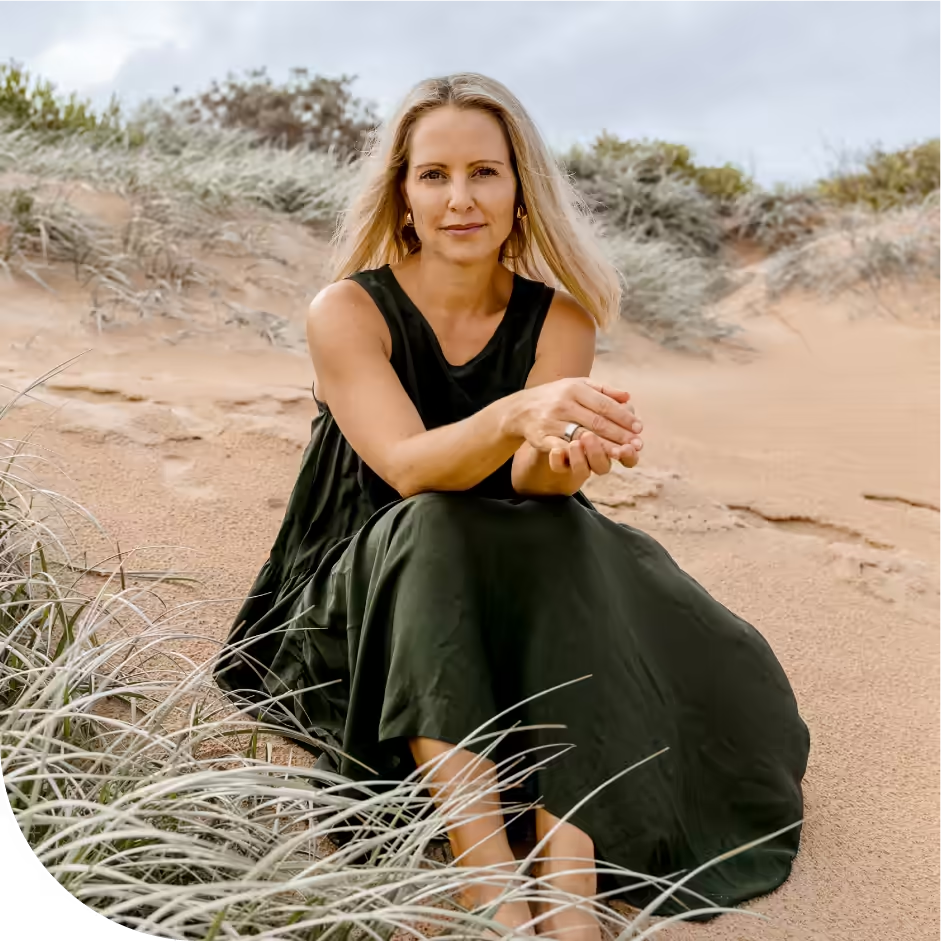
Some scams make headlines but leave deeper scars than the public sees. In this chapter, Author, Speaker, and Advocate Tracy Hall recounts being the final victim of con man Hamish McLaren, revealing how he manipulated her trust and underscoring the need to put people at the center of scam prevention and recovery.
On this page
I’ve asked myself this question about 2,649 times in the last eight years.
Over months, we had hundreds of detailed conversations about his work, investments, world economies, political impacts on global stock exchanges, financial opportunities, and much more. It was convincing.
The story hit the media in 2019 when The Australian released hit podcast Who the Hell Is Hamish?
The human cost of financial crime is rarely discussed. We focus on money lost, the technology required to detect scams, and regulatory frameworks—but not the human toll.
What I’ve come to realize is that it’s surprisingly easy to manipulate human behavior—the most dangerous weapon in a scammer’s toolkit isn’t software, it’s psychology.
Ultimately, the weakest link in the scam ecosystem is humans—you, me, colleagues, parents, kids.
We must design solutions and long-term recovery with humans in mind, supporting victims beyond reimbursement, as psychological and emotional impacts often outweigh the financial.
“How could you be so stupid?”
I’ve asked myself this question about 2,649 times in the last eight years. I’ve also wondered how many others thought the same after hearing my story. I’ve come to accept it’s natural to go there—but I’ve also learned it’s unhelpful and deeply inaccurate.
In 2017, my world came crashing down when I woke up to a Crime Stoppers video of my boyfriend of almost 18 months being arrested outside his Bondi Beach apartment for swindling 15 Australian victims out of $7.6 million.
My boyfriend, Max Tavita—a Chief Investment Officer for a Family Office—was really Hamish McLaren, one of Australia’s most notorious con men. He stole my life savings ($317,000) and, it’s fair to say, my ability to trust.
A Match Made in Deception
We met in early 2016 on a dating app. I’d been separated from my husband for over a year, was working in a demanding marketing role at eBay, and adjusting to single parenting a five-year-old. I wasn’t looking for another husband—just company. Someone with similar interests, values, and humor. I matched with ‘Max’ and our relationship grew slowly. He was athletic and had a down-to-earth lifestyle, even though his work was anything but.
Over months, we had hundreds of detailed conversations about his work, investments, world economies, political impacts on global stock exchanges, financial opportunities, and much more. It was convincing. He shared weekly reports, had Bloomberg monitors that he tinkered on, and spent late nights watching the global markets.
When it came time to discuss my superannuation (pension scheme) and investments, I was so convinced he was exactly who he claimed—a skilled finance professional—that I didn’t even question it. I believed he could help me build my financial future and independence. And I was in love. So, I entrusted him with $317,000.
The Day His Lies Collapsed
Hamish was arrested in July 2017. He was sentenced to 16 years in prison for his crimes against 15 Australian victims, later reduced to 12 on appeal. He will be eligible for parole in July 2026.
The story hit the media in 2019 when The Australian released hit podcast Who the Hell Is Hamish? Through his investigations, journalist Greg Bearup uncovered that Hamish had likely stolen $60–$100 million globally over three decades.
I was his last victim and didn’t even know his real name when he was arrested. Everything about my life with him had been a complete fabrication. At 42, a single mother, I had to start over—financially, emotionally, and psychologically.
The True Price of Trust
The human cost of financial crime is rarely discussed. We focus on money lost, the technology required to detect scams, and regulatory frameworks—but not the human toll. The lives devastated by the greed of others. Some who never recover.
The emotional aftermath of a scam can often be more damaging than the financial losses. It erodes self-trust, corrodes confidence, and lingers far longer than people realize. For me, the price of trust was years of recovery and rebuilding. Learning how to trust the world and myself again after such betrayal has been one of my greatest challenges.
Scammers Hack People, Not Just Systems
I’ve thought a lot about how Hamish managed to manipulate me so successfully. What I’ve come to realize is that it’s surprisingly easy to manipulate human behavior—the most dangerous weapon in a scammer’s toolkit isn’t software, it’s psychology.
Scammers manipulate our brain biases—the mental shortcuts we use to make quick decisions. They exploit the primitive instincts that help us survive, like trust, love, loyalty, fear, and reciprocity, with clinical precision. In my case, Hamish manipulated me using multiple strategies and psychological tactics.
1. He Created a False Persona Matching My Values
Psychological exploitation: Mirroring and halo effect
Hamish crafted an identity that reflected my passions, ambitions, and emotional needs. He claimed to care about the same things and fabricated trauma to manufacture intimacy. This disarmed my critical thinking and created a false sense of familiarity and trust.
2. He Flooded Me with Financial Jargon and Urgency
Psychological exploitation: Cognitive overload, scarcity bias, and authority bias
He bombarded me with investment lingo and unique “opportunities,” making it difficult to dismiss or ignore. He positioned himself as a financial expert, using jargon and props to imply authority, while subtly investigating my personal financial position.
3. He Exploited My Trust and Weaponized Compassion
Psychological exploitation: Emotional manipulation and reciprocity bias
Hamish portrayed himself as a victim of past betrayals and injustices, making me feel emotionally protective of him. He told me his parents died to engender compassion as I too had lost a parent. It was emotional grooming: he turned my empathy into a weapon for his own gain.
4. He Used Gradual Commitment to Erode My Boundaries
Psychological exploitation: Foot-in-the-door technique and normalization
He didn’t ask for large sums up front—he started small. A rare investment opportunity, how much he was making for clients. It built a false sense of reliability and safety. Over time, he pushed the boundaries of what felt “normal,” until I was unknowingly in too deep.
5. He Isolated Me Emotionally
Psychological exploitation: Gaslighting and isolation tactics
He subtly avoided interactions with others. Friends and family were positioned as an inconvenience getting in the way of us spending time together. He created a psychological fortress around the relationship, and I was emotionally alone before I realized it.
“Why Don’t You Just Get Over It and Move On?”
I’ve spent eight years turning something devastating into something useful—writing The Last Victim to show how insidious and layered these crimes are, and speaking worldwide on victim narratives, trust, scam psychology, resilience, and rebuilding. Not because it’s easy, but because it’s essential.
Ultimately, the weakest link in the scam ecosystem is humans—you, me, colleagues, parents, kids. If there’s one thing I want people to understand, it’s this: the most intelligent thing we can do is to humbly accept that fraud could happen to anyone.
Looking Ahead:
People Must Be the Priority
We must design solutions and long-term recovery with humans in mind, supporting victims beyond reimbursement, as psychological and emotional impacts often outweigh the financial.
Education needs to be harder-hitting—desensitization leaves consumers less vigilant, and phishing warnings no longer grab attention. Stories are powerful.
Language matters. Victim-blaming increases stigma and shame, reduces reporting, and stops people from seeking help.
Victims need a single, simple reporting and support pathway, guided by someone who can help them navigate the system. The current system is difficult to deal with, especially when you’re experiencing the impact of trauma and loss.