Summary
Tiny.D, a variant of the Tiny family, has a very small amount of virus code. This variant of Tiny shows an annoying message that is triggered by certain conditions.
Removal
Based on the settings of your F-Secure security product, it will either move the file to the quarantine where it cannot spread or cause harm, or remove it.
A False Positive is when a file is incorrectly detected as harmful, usually because its code or behavior resembles known harmful programs. A False Positive will usually be fixed in a subsequent database update without any action needed on your part. If you wish, you may also:
- Check for the latest database updates
First, check if your F-Secure security program is using the latest updates, then try scanning the file again.
- Submit a sample
After checking, if you still believe the file is incorrectly detected, you can submit a sample of it for re-analysis.
Note: If the file was moved to quarantine, you need to collect the file from quarantine before you can submit it.
- Exclude a file from further scanning
If you are certain that the file is safe and want to continue using it, you can exclude it from further scanning by the F-Secure security product.
Note: You need administrative rights to change the settings.
Technical Details
Tiny.D drops a copy of itself in the Windows System directory as follows:
- %sysdir%\winalert.exe
As a part of Tiny.D's installation routine it adds the following registry entry to enable its automatic execution upon Windows boot up:
- HKLM\Software\Microsoft\Windows\CurrentVersion\Run"Windows Update Notifier" = "%sysdir%\winalert.exe"
Tiny.D checks for the following mutex to ensure that only one instance of itself is running in memory:
- "[Critical_Alert]"
Payload
If any of the following conditions is fulfilled a message will be pop up:
- Day is greater than 20
- Month is not November
- Year is not 2006
Here is the screenshot of the message:
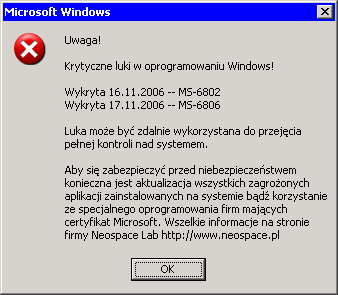
Tiny.D will continually check for the said condition every 10 seconds. But once a message as been shown it will pause for 1 hour before resuming its checking.
Tiny.D is encrypted using xor with 0x8C as its key.
More Support

Community
Ask questions in our Community.

User guides
Check the user guide for instructions.

Contact Support
Chat with with or call an agent.

Submit a Sample
Submit a file or URL for analysis.