

Summary
A remote administration tool (RAT) that bypasses the security features of a program, computer or network to give unauthorized access or control to its user.
Removal
Based on the settings of your F-Secure security product, it will either move the file to the quarantine where it cannot spread or cause harm, or remove it.
A False Positive is when a file is incorrectly detected as harmful, usually because its code or behavior resembles known harmful programs. A False Positive will usually be fixed in a subsequent database update without any action needed on your part. If you wish, you may also:
- Check for the latest database updates
- First, check if your F-Secure security program is using the latest updates, then try scanning the file again.
- Submit a sample
- After checking, if you still believe the file is incorrectly detected, you can submit a sample of it for re-analysis.
- Note: If the file was moved to quarantine, you need to collect the file from quarantine before you can submit it.
- Exclude a file from further scanning
- If you are certain that the file is safe and want to continue using it, you can exclude it from further scanning by the F-Secure security product.
- Note: You need administrative rights to change the settings.
Technical Details
Backdoor:W32/Haxdoor.KI is a powerful backdoor with rootkit and spying capabilities. It can hide its presence, processes and files, on an infected system.
Update - August 25 2006:
The Russia-based skyinet.info website that the backdoor connects to offers a URL that points to a file named samki.exe.
This file contains a nasty payload that damages Windows beyond repair (it renames several files that represent the key Windows components, for example kernel32.dll, explorer.exe and so on, and destroys the Registry database). After system restart, Windows becomes unbootable and damaged beyond repair.
This file can be downloaded and launched by a hacker to destroy all infected computers when the time comes. We have added detection for the payload file into the 2006-08-25_04 update.
Amusingly, Haxdoor.KI can still play such dumb tricks on a user as opening and closing of CD-ROM tray. This is a heritage from the older backdoors like Deep Throat, NetBus, SubSeven and others.
Update - 17 August 2006:
We received numerous reports of Haxdoor.KIbeing spammed as an email attachment, in an archive file named rakningen.zip. The backdoor's file, located inside the archive, is named rakningen.exe (Swedish language) We also have a report that it was spammed inside an archive named rechnung.zip as rechnung.exe. (German language).
Propagation
HaxDoor.KI was spammed to a large amount of people in email messages with the following characteristics:
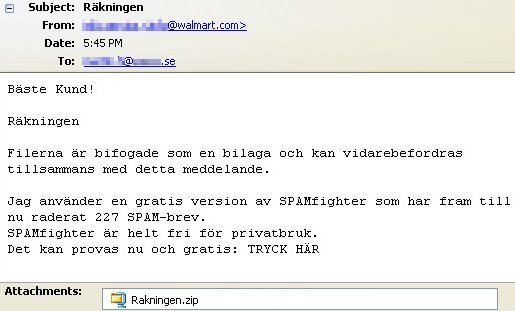
Subject: Rakningen Message Body: Baste Kund! Rakningen Filerna ar bifogade som en bilaga och kan vidarebefordras tillsammans med detta meddelande. Jag anvander en gratis version av SPAMfighter som har fram till nu raderat 227 SPAM-brev. SPAMfighter ar helt fri fr privatbruk. Det kan provas nu och gratis: TRYCK HR Attachment: rakningen.zip We also have a report that it was spammed as rechnung.exe inside an archive named rechnung.zip attached to a message in German.
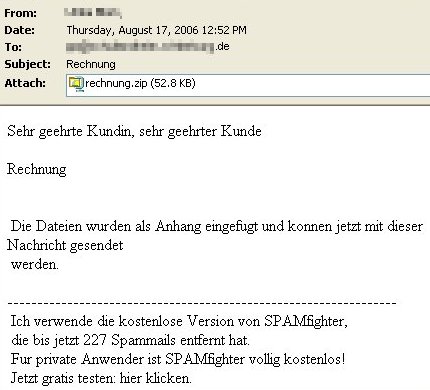
Subject: Rechnung Message Body: Sehr geehrte Kundin, sehr geehrter Kunde Rechnung Die Dateien wurden als Anhang eingefugt und konnen jetzt mit dieser Nachricht gesendet werden. Attachment: rechnung.zip Installation
When the backdoor's file (rechnung.exe or rakningen.exe) is run, it silently drops 5 files to the Windows System folder:
- qo.dll
- qo.sys
- xdpptp.sys
- xopptp.dll
- xopptp.sys
The DLL files are identical to each other, as are the SYS files. During its operation the backdoor creates several different files where it stores stolen data. Those files are encrypted.
When the backdoor is active, all its files are hidden with the help of rootkit techniques. Also, if the backdoor injected its code into the Windows Explorer process, it hides the Explorer.exe process. Otherwise if the backdoor started as a component of the Winlogon process, usually after a system reboot, it hides the Winlogon.exe process. F-Secure products that have an anti-rootkit engine, for example F-Secure Internet Security, can detect and remove the backdoor successfully.
Registry
The DLL files represent the main backdoor's components. To make sure that the backdoor is started every time Windows boots, the Winlogon Notification key for the backdoor's "xopptp.dll" file is added into the Registry:
- [HKLM\Software\Microsoft\Windows NT\CurrentVersion\Winlogon\Notify\xopptp]
This allows the backdoor to start even before a user logs on. Also the backdoor's driver, a file named xdpptp.sys, is registered as a system driver to be loaded even in the minimal configuration (Safe Boot):
- [HKLM\System\CurrentControlSet\Control\SafeBoot\Minimal\xdpptp.sys]
- [HKLM\System\CurrentControlSet\Control\SafeBoot\Network\xdpptp.sys]
- [HKLM\System\ControlSet00?\Control\SafeBoot\Minimal\xdpptp.sys]
- [HKLM\System\ControlSet00?\Control\SafeBoot\Network\xdpptp.sys]
In addition, the backdoor's driver can be registered as a service with the following attributes:
- Name: xdpptp
- Display name: YVPB video output
- File: %WinSysDir%\xdpptp.sys
Where %WinSysDir% represents Windows System directory (usually C:\Windows\System32\).
Activity
It looks like the main purpose of this backdoor, that was created by the virus writer who calls himself 'Corpse', is spying against the users of infected computers.
The stolen info, which includes various logins, passwords, on-line payment systems account details and so on, is sent to a hacker, who can (and probably does) sell it to other criminals.
At the same time the extensive backdoor capabilities and the set of remote control tools that is offered by the virus writer on a commercial basis, makes this malware suitable for spammers, phishers and other computer criminals.
The backdoor collects and sends the following information to a hacker:
- IMAP passwords
- IMAP server name
- IMAP user name
- Inetcomm server passwords
- Outlook account passwords
- POP passwords
- POP server name
- POP user name
- Protected storage passwords
- The Bat! passwords
- Windows registration info
The backdoor can also steal cached MSN, Miranda, ICQ and Webmoney passwords as well as RAS phone numbers and other info related to RAS (username, password, domain, DNS settings).
The backdoor monitors web forms accessed from the infected machine. If the URL or the data inside of the web pages match to a fixed list of online bank-related keywords, then the backdoor will post the content of the form to a server via a web site at the address of skynet.info.
In addition, the backdoor can steal information related to E-Gold, Ebay, and PayPay accounts. These services are widely used for online payments around the world.
Being active, the backdoor injects itself into the processes with the following names:
- explorer.exe
- icq.exe
- iexplore.exe
- mozilla.exe
- msn.exe
- myie.exe
- opera.exe
- outlook.exe
- thebat.exe
The backdoor listens on TCP port 16661 for commands from a remote host. A hacker can connect to that port and control the backdoor's behaviour. The backdoor allows a hacker to do any of the following:
- Upload a specified file to a hacker
- Download a file from a specified location
- View contents of a specified file
- Find any specified file (masks supported)
- Start any specified file
- List files and directories
- Create directories with specified names
- Send an email with a specified text
- Show a messagebox with a specified text
- Full access to Windows Registry
- Enable or disable keylogger, check keylogger status
- Copy data to and from clipboard
- Set cursor position
- Enable or disable keyboard
- Copy, delete, move, get and set attributes to a specified file
- List and kill processes, set priority for a specified process
- Enable and disable hard disks and floppy drives
- Get and set local time
- Set doubleclick time
- Swap mouse buttons
- Take a screenshot from a desktop
- Play specified media files
- Show specified bitmap files
- Change a title of a specified window
- Send a message to any application window
- Create and start services
- Play a beep sound
- Log off, shutdown and restart Windows
- Change color scheme
- Open or close CD-ROM tray
- Unload from memory or uninstall itself from a computer
- Password authentication for a backdoor operator
- Get information about an infected system
- Hide additional files and processes (uses a driver)
- Start HTTP proxy server listening on TCP port 8008
- Start SOCKS v4/5 proxy server listening on TCP port 7080
The backdoor also starts a command shell (cmd.exe) listening on TCP port 16016.
The backdoor blocks connections from an infected computer to the following sites that mostly belong to anti-virus vendors:
- avp.ch
- avp.com
- avp.ru
- awaps.net
- customer.symantec.com
- dispatch.mcafee.com
- download.mcafee.com
- engine.awaps.net
- f-secure.com
- ftp.kaspersky.ru
- ftp.sophos.com
- kaspersky.com
- kaspersky.ru
- kaspersky-labs.com
- liveupdate.symantec.com
- liveupdate.symantecliveupdate.com
- mast.mcafee.com
- mcafee.com
- my-etrust.com
- networkassociates.com
- phx.corporate-ir.net
- rads.mcafee.com
- securityresponse.symantec.com
- service1.symantec.com
- sophos.com
- spd.atdmt.com
- symantec.com
- trendmicro.com
- u2.eset.com
- update.symantec.com
- updates.drweb-online.com
- updates.symantec.com
- us.mcafee.com
- virustotal.com
In addition, it terminates the following security-relayed processes:
- atrack.exe
- FwAct.exe
- iamapp.exe
- jamapp.exe
- mpfagent.exe
- mpftray.exe
- outpost.exe
- vsmon.exe
- zapro.exe
- zlclient.exe
The backdoor disables the VFILT and WSCSVC services to bypass Outpost and Windows Firewalls.
And finally, the backdoor can modify the following settings of Internet Explorer:
- Default search URL
- First homepage
- Local page
- Search page
- Start page
Protect your devices from malware with F‑Secure Total
Protecting your devices from malicious software is essential for maintaining online security. F‑Secure Total makes this easy, helping you to secure your devices in a brilliantly simple way.
- Award‑winning antivirus and malware protection
- Online browsing, banking, and shopping protection
- 24/7 online identity and data breach monitoring
- Unlimited VPN service to safeguard your privacy
- Password manager with private data protection
Choose how many devices you want to protect to get started.
- Free customer support
- Cancel anytime
- The trial does not obligate you to buy the product
After 30 days your subscription will renew automatically for one year at €69.99.


More Support
Community
Ask questions in our Community.
User guides
Check the user guide for instructions.
Contact Support
Chat with our support for assistance.
Submit a Sample
Submit a file or URL for analysis.